


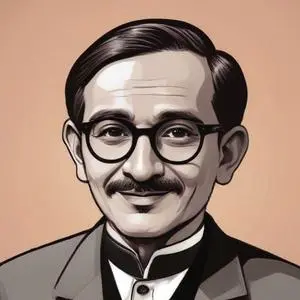
Indian economist, sociologist, and journalist who developed the concept of "Integral Humanism," a philosophy that emphasizes the interconnectedness of individual and national development. He is also known for his work in shaping India's economic and social policies.
Deendayal Upadhyaya, a stalwart of Indian politics, is renowned for drafting the official political doctrine of the Bharatiya Jana Sangh (BJS), the precursor to the Bharatiya Janata Party (BJP). His vision of Integral Humanism, a unique blend of cultural nationalism, Gandhian socialism, and social welfare, continues to shape Indian politics and society.
Born on September 25, 1916, in Nagla Chandraban, Mathura District, Uttar Pradesh, Deendayal Upadhyaya belonged to a Brahmin family. Orphaned at the tender age of eight, he was brought up by his maternal uncle and aunt. Despite the odds, he excelled in his education, winning a gold medal and a monthly scholarship from the Maharaja of Sikar.
He pursued his intermediate studies at Pilani, Rajasthan, and later graduated with a BA degree from Sanatan Dharma College, Kanpur. Upadhyaya was all set to pursue his master's degree in English literature at St. Johns College, Agra, but financial constraints forced him to abandon his studies.
Deendayal Upadhyaya's tryst with politics began in 1937 when he came into contact with the Rashtriya Swayamsevak Sangh (RSS) through a classmate, Baluji Mahashabde. His intellectual discussions with the RSS founder, K. B. Hedgewar, marked the beginning of his journey as a prominent figure in Indian politics.
In the 1940s, Upadhyaya started the monthly publication Rashtra Dharma, which aimed to promote the ideals of Hindutva revival and Integral Humanism. This publication became a powerful medium for spreading his vision of a self-reliant India, rooted in its cultural heritage.
Upadhyaya's magnum opus, Integral Humanism, is a philosophy that seeks to harmonize individual and national development. By integrating cultural nationalism with Gandhian socialist principles, such as sarvodaya (progress of all) and swadeshi (self-sufficiency), he presented a unique approach to nation-building.
Integral Humanism emphasizes the importance of decentralization, swaraj (self-rule), and the empowerment of rural India. This philosophy has had a lasting impact on Indian politics, influencing the BJP's ideology and shaping the country's development policies.
Deendayal Upadhyaya's contributions to Indian politics and society are immense. He played a pivotal role in shaping the BJP's ideology, and his philosophy of Integral Humanism continues to inspire generations of Indian politicians and thinkers.
His life's work serves as a testament to his unwavering commitment to social welfare and national development. As a champion of inclusive growth, Upadhyaya's legacy continues to inspire Indians to strive for a self-reliant and culturally rooted nation.
As we reflect on Deendayal Upadhyaya's remarkable life and legacy, it becomes clear that his vision of Integral Humanism continues to shape India's development trajectory. His commitment to social welfare, cultural nationalism, and inclusive growth serves as a beacon of inspiration for generations to come.
Born in 1924
A renowned Indian poet and politician who served as the country's 10th Prime Minister, known for his efforts to strengthen India's economy and improve relations with neighboring countries.
76 Years Old
The Chief Minister of Gujarat and 14th Prime Minister of India, a prominent figure in Indian politics, known for his economic reforms and nationalist agenda. He has been a dominant force in Indian politics for over two decades.
92 Years Old
A prominent Indian politician who served as the Human Resource Development Minister, known for his efforts in reforming India's education system and promoting Hindu nationalism.
