


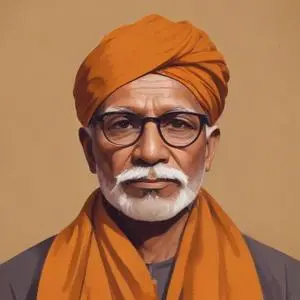
Founded the Rashtriya Swayamsevak Sangh (RSS), a Hindu nationalist organization, and played a key role in shaping India's right-wing politics. He's revered as a hero and ideologue by many in India's Hindu nationalist movement.
Keshav Baliram Hedgewar, fondly known as Doctorji, was an Indian political and social activist, physician, and the founder of the Rashtriya Swayamsevak Sangh (RSS), a prominent Hindu nationalist organization. He is revered for his tireless efforts in promoting Indian nationalism and shaping the country's socio-political landscape.
Hedgewar was born on April 1, 1889, in a Marathi Deshastha Brahmin family in Nagpur, Maharashtra. His ancestors hailed from the Telugu village of Kandakurthi, Nizamabad district in present-day Telangana. After losing his parents to the Plague Epidemic of 1902 at the tender age of 13, Hedgewar's uncle ensured that he received a good education. He studied at Neel City High School in Nagpur and later at the Rashtriya Vidyalaya in Yavatmal and Pune.
Hedgewar's initiation into the Anushilan Samiti in Bengal, a group rooted in Hindu symbolism, played a significant role in shaping his ideology. He was deeply influenced by the writings of Bankim Chandra Chatterjee and Vinayak Damodar Savarkar's treatise Hindutva. These influences laid the foundation for his later work in promoting Indian nationalism.
In 1925, Hedgewar founded the Rashtriya Swayamsevak Sangh (RSS) in Nagpur, based on the ideology of nationalism. The RSS aimed to promote Hindu values and unity, and Hedgewar's leadership played a crucial role in shaping the organization's early years.
Hedgewar's philosophy was deeply rooted in Hindu nationalism, and he believed in the concept of Hindu Rashtra (Hindu Nation). He emphasized the need for Hindu unity and self-reliance, and his ideas continue to influence Indian politics and society to this day.
Hedgewar's legacy is profound, and his contributions to Indian nationalism are undeniable. He played a significant role in shaping the country's socio-political landscape, and his influence can be seen in various aspects of modern Indian society.
Hedgewar's legacy has been subject to controversy, with some critics accusing him of promoting Hindu fundamentalism and communalism. However, his supporters argue that his ideology was rooted in promoting Hindu unity and self-reliance, rather than promoting hatred towards other communities.
Hedgewar's influence can be seen in various aspects of modern Indian society, including politics, education, and social activism. His emphasis on Hindu unity and self-reliance continues to inspire many, and his legacy remains a subject of debate and discussion.
In conclusion, Keshav Baliram Hedgewar's life and work have had a profound impact on Indian society and politics. His legacy continues to inspire and influence generations, and his contributions to Indian nationalism remain unparalleled.
Born in 1916
Indian economist, sociologist, and journalist who developed the concept of "Integral Humanism," a philosophy that emphasizes the interconnectedness of individual and national development. He is also known for his work in shaping India's economic and social policies.
Born in 1924
A renowned Indian poet and politician who served as the country's 10th Prime Minister, known for his efforts to strengthen India's economy and improve relations with neighboring countries.
76 Years Old
The Chief Minister of Gujarat and 14th Prime Minister of India, a prominent figure in Indian politics, known for his economic reforms and nationalist agenda. He has been a dominant force in Indian politics for over two decades.
75 Years Old
The current Union Home Minister of India, responsible for the country's internal security and law enforcement, known for his strong stance on national security and defense.
74 Years Old
Indian Minister of External Affairs who played a crucial role in shaping India's foreign policy and was known for her exceptional oratory skills and humanitarian work. She was a powerful voice for Indian diplomacy and a champion of women's empowerment.
