


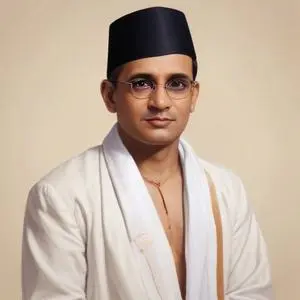
A key figure in India's struggle for independence, he's known for his advocacy of Hindu nationalism and his role in the country's freedom movement.
Vinayak Damodar Savarkar, a multifaceted Indian politician, activist, and writer, is renowned for developing the Hindu nationalist ideology of Hindutva. His vision for a unified Hindu nation, free from British colonial rule, inspired a generation of freedom fighters and continues to shape India's political landscape.
Savarkar was born on May 28, 1883, in Bhagur, a small village in the Nashik district of Maharashtra. His early life was marked by a sense of nationalism, which was evident in his involvement with the Abhinav Bharat Society, a secret society founded by him and his brother in 1904. This society aimed to promote Indian independence through revolutionary means.
Savarkar's journey to the United Kingdom in 1906 to pursue his law studies proved to be a turning point in his life. He became involved with organizations like India House and the Free India Society, which further fueled his nationalist sentiments. During this period, he wrote several books advocating complete Indian independence, including The Indian War of Independence, which was banned by the British colonial authorities.
In 1910, Savarkar was arrested by the British government and ordered to be extradited to India for his connections with India House. On the voyage back to India, he attempted to escape from the steamship SS Morea and seek asylum in France while the ship was docked in the port of Marseilles. Although the French authorities handed him back to the British, this daring attempt earned him the prefix "Veer" (brave) from his followers.
Savarkar was sentenced to life terms of imprisonment totaling fifty years and was moved to the Cellular Jail in the Andaman and Nicobar Islands. He spent several years in this harsh prison, where he was subjected to forced labor and inhumane treatment.
In 1924, Savarkar was released from prison after he wrote a series of mercy petitions to the British. Although he was released, he was restricted to the Ratnagiri district. During this period, he continued to advocate for Hindu political and social unity, and his writings and speeches inspired a new generation of Indians to fight for independence.
After being released from his restriction to Ratnagiri district in 1937, Savarkar traveled widely, becoming a forceful orator and writer. He advocated for Hindu political and social unity, and his addresses, including the Ahmedabad address, are still remembered for their eloquence and passion.
Savarkar's philosophy of Hindutva emphasized the need for Hindu unity and political consolidation. He believed that Hindus and Muslims were two distinct nations, and that India should be a Hindu-majority nation. His ideas continue to shape India's political discourse, with many Hindu nationalist organizations drawing inspiration from his work.
Vinayak Damodar Savarkar's life and work had a profound impact on India's struggle for independence and the country's subsequent political landscape. His vision for a unified Hindu nation continues to influence Indian politics, and his legacy is revered by millions of Indians.
Today, Savarkar is remembered as a brave freedom fighter, a passionate orator, and a prolific writer. His ideas, although controversial, continue to inspire and provoke discussion on India's national identity and the role of Hinduism in the country's politics.
Born in 1865
A leading figure in India's struggle for independence from British rule, known for his role in the Indian independence movement and his advocacy for Hindu-Muslim unity.
Born in 1856
A leading figure in India's independence movement, he used his writings and oratory skills to inspire and mobilize the masses against British rule. He's known as the "Father of the Indian Unrest" for his bold and provocative ideas.
Born in 1869
Indian freedom fighter, activist, and philosopher who led India to independence from British rule through non-violent civil disobedience, inspiring civil rights movements worldwide.
Born in 1897
Indian freedom fighter and politician who led the Indian National Army against British rule and was a key figure in the country's struggle for independence. He is also known for his mysterious disappearance in 1945.
Born in 1889
India's first Prime Minister, a key figure in the country's struggle for independence from British rule, and a champion of democracy and secularism. He played a crucial role in shaping modern India's government and economy.
Born in 1907
An Indian socialist revolutionary who fought for independence from British rule through dramatic acts of defiance, including a bombing of the Indian Assembly and a hunger strike that led to his execution.
Born in 1884
India's first president, a key figure in the country's struggle for independence, who played a crucial role in shaping the nation's early years. He's revered for his leadership and commitment to democracy.
