


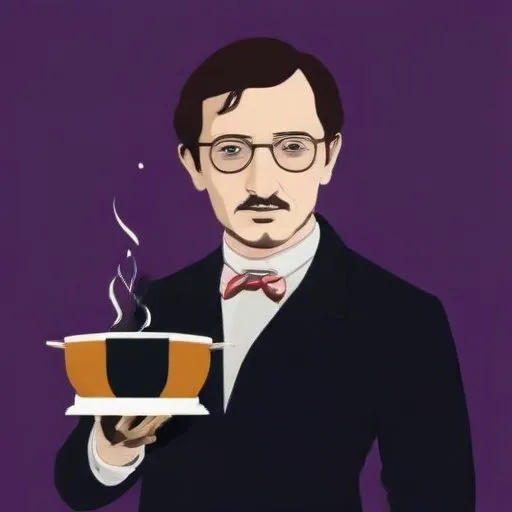
A 17th-century French physicist and mathematician who developed the pressure cooker, revolutionizing cooking techniques and food preservation. His invention enabled faster cooking times and paved the way for modern cooking methods.
Denis Papin, a French physicist, mathematician, and inventor, is renowned for his groundbreaking invention of the steam digester, a precursor to the pressure cooker and steam engine. This pioneering innovation not only revolutionized cooking but also paved the way for the development of modern steam power.
Born on August 22, 1647, in Chitenay, Loiret, Centre-Val de Loire, France, Papin was educated at a Jesuit school in his hometown. He later attended the University of Angers, graduating with a medical degree in 1669.
In 1673, Papin worked alongside Christiaan Huygens and Gottfried Leibniz in Paris, where he became fascinated with the potential of vacuums to generate motive power. This fascination eventually led him to invent the steam digester, a type of pressure cooker equipped with a safety valve, during his time in London between 1676 and 1679.
Papin's work with Robert Boyle in London resulted in the publication of his findings in Continuation of New Experiments in 1680. His innovative designs and theories earned him recognition from the Royal Society, which he addressed in 1679.
The steam digester, Papin's most notable invention, was a radical departure from traditional cooking methods. By harnessing the power of steam, Papin's design enabled faster and more efficient cooking, while also reducing the risk of explosions. This invention laid the groundwork for the development of modern pressure cookers and steam engines.
As a Huguenot, Papin faced increasing persecution in France, leading him to flee to Germany in 1687. There, he found refuge among fellow Huguenot exiles and continued to pursue his scientific endeavors.
In Germany, Papin developed a model of a piston steam engine, the first of its kind, in 1690. He later refined his design with the help of Gottfried Leibniz, creating a more advanced steam engine in 1705.
Papin's contributions to the fields of physics and engineering have had a lasting impact on modern society. His work on steam power paved the way for the Industrial Revolution, transforming the way goods were produced and economies functioned.
In recognition of his groundbreaking work, Papin was elected a Fellow of the Royal Society in 1680. His legacy continues to inspire scientists and engineers, ensuring his place as one of the most influential thinkers of his time.
Through his remarkable life and work, Denis Papin has left an indelible mark on the development of modern science and technology, inspiring generations of scientists and engineers to build upon his groundbreaking innovations.
Born in 1623
A 17th-century genius who made major contributions to mathematics, physics, and philosophy, inventing the mechanical calculator and developing the theory of probability. His writings also explored the human condition and faith.
Born in 1629
A 17th-century polymath who made groundbreaking contributions to optics, probability theory, and astronomy, including the discovery of Saturn's rings and the largest moon, Titan.
Born in 1646
Developed calculus independently of Isaac Newton, and made major contributions to the fields of philosophy, politics, and history.
Born in 1627
Pioneering scientist who discovered Boyle's Law, which describes the relationship between pressure and volume of gases, and laid foundations for modern chemistry.
Born in 1743
Father of modern chemistry, discovered oxygen, and developed a systematic method of chemical nomenclature. He laid the foundation for modern chemistry and paved the way for future scientific discoveries.
Born in 1728
Discovered magnesium and isolated carbon dioxide, making significant contributions to the field of chemistry.
Born in 1731
A pioneering scientist who discovered hydrogen and determined the density of the Earth, making significant contributions to the fields of chemistry and physics.
