


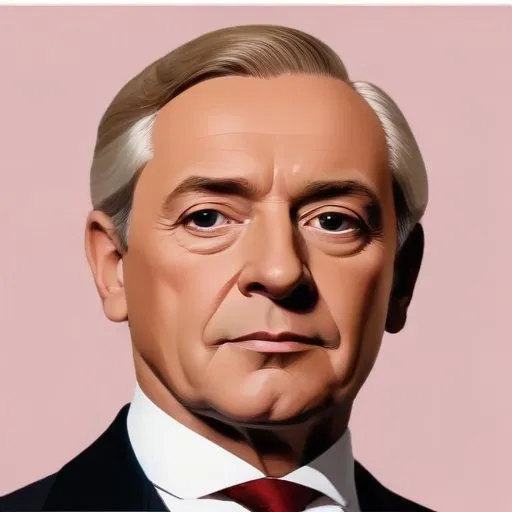
Leader of the Long Parliament and a key figure in the English Civil War, known for his role in the trial and execution of King Charles I.
Denzil Holles, 1st Baron Holles, is remembered as one of the Five Members whose attempted arrest by Charles I in January 1642 sparked the First English Civil War. This pivotal event marked the beginning of a tumultuous period in English history, and Holles' role in it would forever shape his legacy as a statesman and politician.
Born on October 31, 1598, Denzil Holles was the second surviving son of John Holles, 1st Earl of Clare, and his wife Anne Stanhope. He had four siblings who lived into adulthood, including Arabella, who married Thomas Wentworth, 1st Earl of Strafford. Holles' family was steeped in wealth and influence, setting the stage for his future career in politics.
When fighting began in August 1642, Holles raised a Parliamentarian regiment, which fought at Edgehill before it was nearly destroyed at Brentford in November 1642. This marked the end of Holles' military career, and he became leader of the Parliamentarian Peace Party, advocating for a negotiated settlement with the king.
Holles' conservative social views and opposition to political radicals like the Levellers and religious Independents like Oliver Cromwell led to his suspension from Parliament in June 1647. He was recalled prior to the Second English Civil War in June 1648 but was excluded again by Pride's Purge in December. Holles went into exile, where he remained until 1654.
After the Restoration of 1660, Charles II made Holles Baron Holles and appointed him Ambassador to France from 1663 to 1666. Although this appointment proved unsuccessful, Holles continued to play a significant role in politics, gradually becoming part of the Whig opposition. He backed the 1673 Test Act and advocated for the exclusion of the Catholic heir, James, Duke of York, in 1679.
Holles died on February 17, 1680, and was buried in Westminster Abbey. One biographer succinctly summarized his career, stating that "successful in almost everything he privately undertook, he was unsuccessful in almost everything he publicly undertook, while his passionate parliamentarianism was constantly counterproductive." Despite this, Holles' contributions to English politics and history are undeniable, and his legacy continues to fascinate historians and scholars to this day.
Holles' life and career were deeply entwined with the complex and tumultuous period of the English Civil Wars. His passionate parliamentarianism and conflicted relationships with radicals and royalists alike shaped his legacy and continue to fascinate historians today. Despite his mixed successes and failures, Holles remains an important figure in English history, a testament to the complexities and contradictions of human nature.
Born in 1626
Lord Protector of Great Britain from 1658 to 1659, he briefly succeeded his father Oliver Cromwell, but was overthrown and exiled, leaving a legacy of failed attempts to restore the monarchy.
