


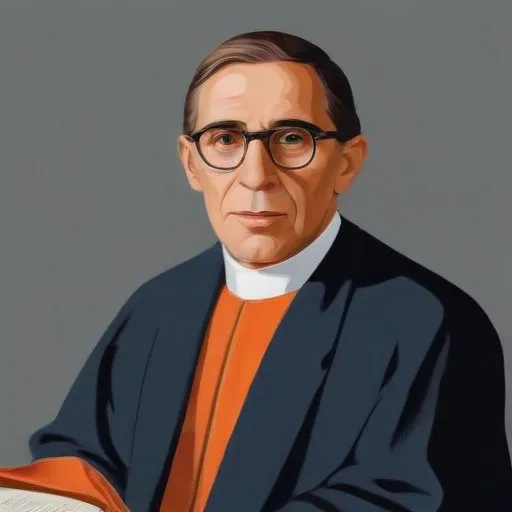
A German Catholic philosopher and author who wrote extensively on ethics, morality, and aesthetics, influencing Catholic thought and inspiring a new generation of theologians.
Dietrich von Hildebrand, a German Roman Catholic philosopher and religious writer, is known for his profound contributions to the world of philosophy, particularly in the realms of ethics, metaphysics, and aesthetics. He is hailed as the 20th century's Doctor of the Church by Pope Pius XII, a title reserved for the most illustrious theologians and philosophers in the Catholic tradition.
Born on October 12, 1889, in Florence, Italy, Hildebrand grew up in a secular German household, surrounded by art and culture. His father, Adolf von Hildebrand, was a renowned sculptor, and his mother, Irene Schuffelen, instilled in him a deep sense of beauty and value. Despite being raised without religion, Hildebrand developed a profound respect for the sacred and the beautiful from an early age.
Hildebrand's philosophical work spanned every major field, including ethics, metaphysics, epistemology, philosophical anthropology, social philosophy, and aesthetics. He was a leading figure in the realist phenomenological and personalist movements, influencing thinkers such as Pope John Paul II and Benedict XVI. His philosophical contributions were characterized by a strong emphasis on the human person, the importance of beauty, and the role of values in human existence.
Hildebrand's work had a profound impact on modern society, shaping the Catholic Church's understanding of ethics, morality, and human dignity. His influence extended beyond the realm of philosophy, informing the work of theologians, priests, and laypeople alike. In 1971, Pope John Paul II remarked to Hildebrand's widow, "Your husband is one of the great ethicists of the 20th century."
Hildebrand's legacy extends beyond the realm of philosophy, informing the Catholic Church's understanding of human dignity, morality, and ethics. His influence can be seen in the work of contemporary thinkers, theologians, and priests. As Benedict XVI remarked, "When the intellectual history of the Catholic Church in the 20th century is written, the name of Dietrich von Hildebrand will be most prominent among the figures of our time."
"The heart is the root of all true knowledge, because it is the source of all love and all sacrifice."
"Beauty is the splendor of truth."
Dietrich von Hildebrand's life and work are a testament to the power of philosophy to shape our understanding of the human person and our relationship with God. As a thinker, writer, and philosopher, he left an indelible mark on the Catholic Church and the world at large. His legacy continues to inspire and inform contemporary thinkers, ensuring that his work remains a beacon of light in the pursuit of truth, beauty, and goodness.
Born in 1920
Leader of the Catholic Church from 1978 to 2005, known for helping to end communism in Poland and being a charismatic advocate for human rights and social justice.
99 Years Old
The first pope to resign in nearly 600 years, he's known for his conservative views and efforts to strengthen the Catholic Church's traditional teachings. He's also a prolific writer and theologian.
Born in 1904
A German priest and theologian who sought to reconcile Catholicism with modern philosophy, exploring the intersection of faith and reason. His work greatly influenced 20th-century Catholic theology.
Born in 1891
A Polish nun who converted from Judaism and was martyred in Auschwitz, known for her philosophical writings and devotion to God. She's a symbol of faith and resilience in the face of persecution.
