


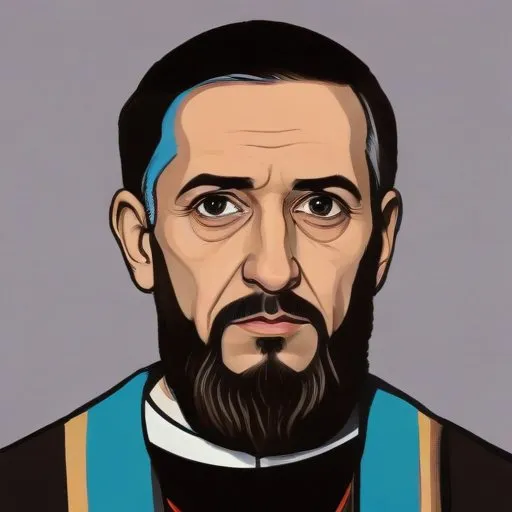
A Greek Orthodox priest and scholar who made significant contributions to the study of ancient Greek language and literature, particularly in the field of paleography.
Dimitrios Holevas, more commonly known as Papa-Holevas, was a Greek Orthodox priest who played a significant role in the Greek resistance movement against the Axis occupation during World War II. As a member of the Greek People's Liberation Army (ELAS) and the National Liberation Front (EAM), Holevas' bravery and dedication earned him recognition and respect from his contemporaries.
Holevas was born on January 26, 1907, in the village of Tsouka, Phthiotis. He grew up in Makrakomi and pursued higher education, studying Literature and Archaeology at the University of Athens and the University of Thessaloniki.
In 1938, Holevas was ordained as a priest, but his true calling lay in the fight against the Axis occupation. In 1942, he joined ELAS, adopting the nom de guerre "Papaflessas." As a military priest of ELAS' 13th Division, Holevas played a crucial role in the resistance movement, inspiring his comrades with his bravery and spiritual leadership.
Holevas' commitment to the cause led him to organize a council of priests at Spercheiada in 1943. He also founded the Panclerical Orthodox Clergy Union, which grew to have 4,000 members. Holevas was elected as the General Secretary of the union, solidifying his position as a prominent figure in the Greek resistance.
After the war, Holevas faced persecution for his support of ELAS. The Synodal Court suspended him from the clergy for three years, and in 1947, he was sent into internal exile in Ikaria. Despite these challenges, Holevas continued to teach in schools, sharing his knowledge with others.
In 2001, the Holy Synod of the Church of Greece honored Holevas with the Gold Cross of St. Paul for his activity during the Resistance. This recognition came decades after his initial persecution, a testament to the enduring impact of his contributions.
Holevas was married and had five children. His family remained a source of strength and support throughout his life, even as he faced challenges and persecution.
Holevas' bravery and dedication to the Greek resistance movement serve as an inspiration to future generations. His legacy reminds us of the importance of standing against oppression and fighting for what is right, even in the face of adversity.
- "Faith is not just a matter of prayer, but of action." - Dimitrios Holevas
Holevas' quote captures the essence of his life's work, emphasizing the importance of putting one's beliefs into practice. His unwavering commitment to the Greek resistance movement serves as a testament to the power of faith and action.
Dimitrios Holevas' life and legacy are a testament to the bravery and resilience of the Greek people during World War II. His contributions to the resistance movement and his commitment to his faith serve as an inspiration to all who seek to make a difference in the world.
Born in 1748
A Greek-French philosopher and scholar who played a key role in the Greek Enlightenment, modernizing Greek education and language, and promoting democratic and liberal ideas. His work laid the groundwork for the emergence of modern Greece.
Born in 1789
A Greek Orthodox priest and philosopher who advocated for education and social reform, and is considered one of the most important figures of the Greek Enlightenment.
