


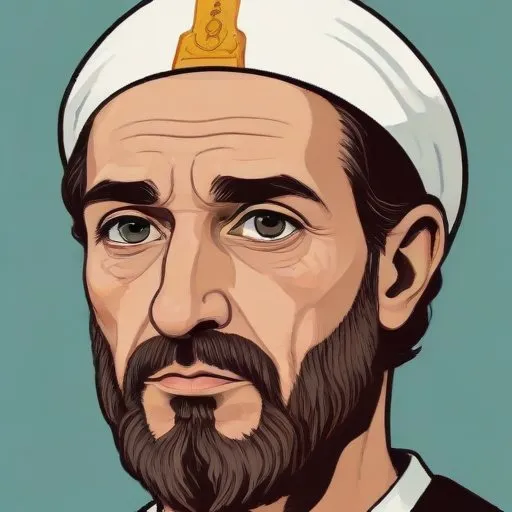
A Greek Orthodox priest and philosopher who advocated for education and social reform, and is considered one of the most important figures of the Greek Enlightenment.
Theophilos Kairis was a Greek priest, philosopher, and revolutionary who played a pivotal role in the Greek War of Independence against the Ottoman Empire. He is best known for declaring the War of Independence in 1821 and raising the Greek flag at the picturesque cliffside church of St. George on the island of Andros, inspiring shipowners and merchants to contribute funds and ships to build a Greek Navy.
Born on October 19, 1784, in Andros, Cyclades, Ottoman Greece, Kairis hailed from a distinguished family. He studied at the theological school of Smyrna and was ordained a Greek Orthodox priest. His linguistic proficiency extended to Ancient Greek, Latin, Italian, French, German, and English, which enabled him to engage with contemporaries and absorb diverse intellectual influences.
Kairis's thirst for knowledge led him to study mathematics, natural sciences, and philosophy in Pisa and Paris, where he was exposed to the ideas of the Age of Enlightenment. He was also fascinated by archaeology, making significant discoveries on his native island of Andros. Additionally, he had a passion for botany, cataloging local plants and documenting their pharmacologic properties.
From 1811, Kairis led Greek language high schools in Asia Minor, laying the groundwork for his future revolutionary endeavors. Between 1819 and 1826, he actively participated in the Greek War of Independence, solidifying his position as a key figure in Modern Greek history.
On May 10, 1821, Kairis delivered a heartfelt speech, known as "Rhetoras," at the church of St. George on Andros, urging shipowners and merchants to support the war effort by contributing funds and ships. This pivotal moment inspired the nation and marked the beginning of a new era in Greek history.
Kairis's contributions to the Greek War of Independence and the establishment of a modern Greek state are immeasurable. He is revered as a national hero, and his legacy continues to inspire future generations. His commitment to education, science, and philosophy has left an indelible mark on Greek culture and society.
Kairis was deeply influenced by the ideas of the Enlightenment, which shaped his understanding of humanity, equality, and liberty. His philosophical beliefs were rooted in the principles of reason, justice, and human dignity, reflecting his commitment to the ideals of the Greek Revolution.
Kairis's legacy extends beyond his role in the Greek War of Independence. His commitment to education, science, and philosophy has inspired numerous generations of Greeks, shaping the nation's cultural and intellectual identity. His ideas continue to influence modern Greek society, fostering a sense of patriotism, national pride, and social responsibility.
Kairis's life and work are inextricably linked to the historical context of the Greek War of Independence and the formation of Modern Greece. His contributions have secured his place as one of the most important figures in Greek history, alongside other notable revolutionaries and intellectuals of the era.
Theophilos Kairis's remarkable life and achievements have left an indelible mark on Greek history and culture. His commitment to the cause of independence, his passion for knowledge, and his dedication to education have inspired generations, cementing his place as a national hero and a champion of Modern Greece.
Born in 1748
A Greek-French philosopher and scholar who played a key role in the Greek Enlightenment, modernizing Greek education and language, and promoting democratic and liberal ideas. His work laid the groundwork for the emergence of modern Greece.
Born in 1776
First Governor of Greece, credited with establishing the country's modern state and government, and implementing reforms to unify and stabilize the newly independent nation.
