


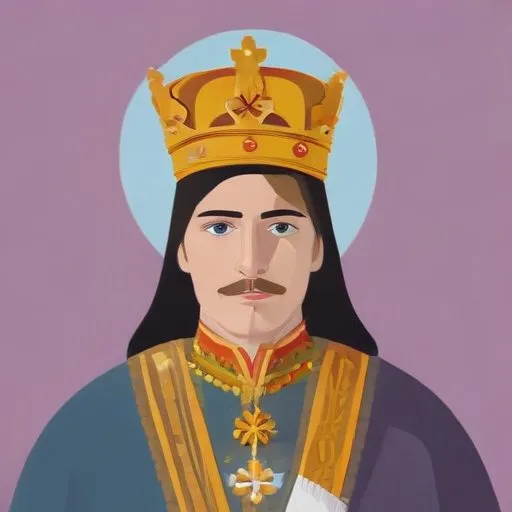
The youngest son of Ivan the Terrible, a Russian crown prince who was brutally murdered at a young age, sparking a dynastic crisis and earning him sainthood. He's revered for his innocence and tragic fate.
Dmitry Ivanovich, also known as Dmitry of Uglich, was the youngest son of Ivan the Terrible and the last wife, Maria Nagaya. He is primarily remembered as the tsarevich who was next in line to the throne during his half-brother Feodor I's reign, only to meet an untimely and mysterious death, leading to one of the most tumultuous periods in Russian history, the Time of Troubles.
Born on October 19, 1582, Dmitry was the only child of Ivan the Terrible and Maria Nagaya. Following Ivan's death in 1584, Dmitry's older brother Feodor I succeeded to the throne, with Boris Godunov, Feodor's brother-in-law, heading the regency council. In 1586, Godunov sent Dmitry, along with his mother and her brothers, into internal exile in the tsarevich's appanage of Uglich, a move that would ultimately prove to be a turning point in Dmitry's life.
On May 15, 1591, Dmitry died under circumstances that remain shrouded in mystery to this day. The event sparked a flurry of speculation, with many believing that Godunov was behind the young tsarevich's demise. The lack of a clear successor led to a power vacuum, which Godunov eventually exploited to claim the throne for himself after Feodor I's death in 1598.
Russian chroniclers and historians have proposed two main theories regarding Dmitry's death. The first, supported by prominent historians such as Nikolai Karamzin, Sergei Soloviev, and Vasily Klyuchevsky, suggests that Godunov orchestrated the assassination to clear the way for his own succession. However, critics argue that Dmitry's illegitimate status, as Ivan the Terrible's son from his fourth marriage, rendered his claim to the throne dubious. Modern scholarship leans towards exonerating Godunov of any involvement in the prince's death.
Dmitry of Uglich's untimely demise had far-reaching consequences for Russia, setting the stage for the Time of Troubles, a period marked by dynastic strife, power struggles, and foreign invasions. The lack of a clear heir led to a succession crisis, which Godunov exploited to establish himself as the new ruler. Moreover, Dmitry's death led to a proliferation of impostors, claiming to be the rightful heir, further destabilizing the already precarious Russian political landscape.
The repercussions of Dmitry's death continue to echo through Russian history, shaping the nation's political trajectory and influencing the development of its monarchical system. The mysterious circumstances surrounding his death have captivated the imagination of historians, scholars, and writers, inspiring numerous literary and artistic works, including plays, novels, and operas.
In conclusion, Dmitry of Uglich's life, though brief, had a profound impact on Russian history, precipitating a chain of events that would shape the course of the nation's development. His enigmatic death continues to intrigue scholars and historians, fueling debate and speculation to this day.
Born in 1661
Tsar of Russia from 1676 to 1682, known for his attempts to reform the Russian Orthodox Church and reduce the power of the nobility.
Born in 1666
The last of the weak and ineffective rulers of the House of Romanov, known for being mentally disabled and used as a puppet by his sister Sophia, who ruled in his place.
