


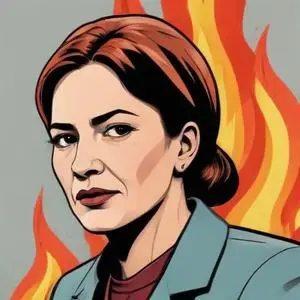
A Spanish revolutionary leader who fought for workers' rights and social justice, becoming a symbol of resistance against fascism and oppression.
Dolores Ibarruri, affectionately known as "La Pasionaria" (The Passion Flower), was a Spanish Republican politician and communist who rose to prominence during the Spanish Civil War (1936-1939). Her iconic slogan "No Pasarán" (They Shall Not Pass) echoed throughout the Battle of Madrid in November 1936, cementing her place in history as a symbol of resistance against fascism.
Born on December 9, 1895, in the Basque region of Spain, Ibarruri was the eighth of nine children. Her parents, a Basque miner father and a Castilian mother, instilled in her a strong sense of social justice. After leaving school at 15, she worked as a seamstress and later as a housemaid, eventually becoming a waitress in the town of Arboleda.
It was during this period that she met her husband, Julín Ruiz Gabia, a union activist and founder of the Socialist Youth of Somorrostro. Together, they participated in the general strike of 1917, marking the beginning of Ibarruri's involvement in the labor movement.
In 1920, Ibarruri joined the Spanish Communist Party (PCE) and became a writer for the party's publication, Mundo Obrero. Her writing skills and oratory prowess quickly made her a prominent figure within the party. In February 1936, she was elected to the Cortes Generales as a PCE deputy for Asturias.
During the Spanish Civil War, Ibarruri's passionate speeches and unwavering commitment to the Republican cause earned her the nickname "La Pasionaria." Her leadership and influence played a significant role in rallying the Spanish people against the fascist forces of General Francisco Franco.
Following the defeat of the Republican forces in 1939, Ibarruri went into exile, eventually becoming the General Secretary of the Central Committee of the PCE from 1942 to 1960. The party later named her honorary president, a position she held until her death.
In 1977, Ibarruri returned to Spain and was reelected as a deputy to the Cortes for the same region she had represented from 1936 to 1939. She continued to advocate for social justice and democracy until her passing on November 12, 1989.
Dolores Ibarruri's legacy extends far beyond her remarkable life. Her unwavering commitment to socialism, democracy, and human rights has inspired generations of social activists and politicians. Her iconic slogan "No Pasarán" continues to resonate as a symbol of resistance against oppression and fascism.
Today, Ibarruri's legacy serves as a reminder of the importance of standing up against injustice and fighting for a more just and equitable society. Her life and work continue to inspire people around the world to take action and make a difference.
As we reflect on the life and legacy of Dolores Ibarruri, we are reminded of the power of courage, conviction, and determination. Her extraordinary journey serves as a testament to the human spirit's capacity to inspire and transform the world around us.
Born in 1892
A Spanish physician and politician who served as Prime Minister of Spain during the Spanish Civil War, known for his efforts to maintain democracy and resist fascist forces.
Born in 1915
A Spanish general and politician who played a key role in the Spanish Civil War and later became the leader of the Communist Party of Spain, advocating for democracy and human rights.
Born in 1892
The authoritarian leader who ruled Spain with an iron fist from 1939 to 1975, suppressing opposition and imposing conservative values, while also modernizing the economy. He's infamous for his brutal regime and human rights abuses.
