


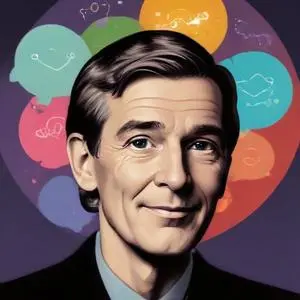
Developed influential theories on meaning, truth, and the nature of language, challenging traditional notions of reference and interpretation. His work has had a significant impact on the development of analytic philosophy.
Donald Davidson, a towering figure in modern philosophy, is renowned for his groundbreaking contributions to the philosophy of mind, language, and action theory. His work has had a profound impact on the way we think about meaning, reality, and the human experience.
Davidson's philosophical framework revolves around the concept of anomalous monism, which posits that mental events are a product of physical events in the brain, but cannot be reduced to them. This distinctive approach challenged the traditional mind-body dualism, and his arguments have had far-reaching implications for our understanding of consciousness, free will, and the nature of reality.
Davidson's influential essays, compiled in Essays on Actions and Events (1980) and Inquiries into Truth and Interpretation (1984), showcase his mastery of linguistic and philosophical analysis. His seminal work, "Truth and Meaning" (1967), is considered a classic in the philosophy of language. Davidson's intellectual rigor and innovative thinking earned him the Slusser Professorship of Philosophy at the University of California, Berkeley, a position he held from 1981 until his passing in 2003.
Born on March 6, 1917, Davidson grew up in a family of modest means in Pennsylvania. He served in the US Navy during World War II, an experience that shaped his perspective on human nature and morality. Davidson's personal life was marked by three marriages, including his final union with philosopher Marcia Cavell, with whom he shared a deep intellectual and emotional bond.
In his 1987 paper "Knowing One's Own Mind," Davidson introduced the now-famous Swampman thought experiment. This daring scenario posits that, in a freak accident, Davidson is simultaneously killed and replaced by an exact physical duplicate, Swampman, created from a nearby tree. Davidson argues that, despite their identical physical composition, Swampman lacks thoughts, meaning, and intentionality, as these arise from complex interactions with the world, rather than mere physical structure.
Davidson's ideas have resonated across disciplines, influencing literary theory, cognitive science, and analytic philosophy. His work has inspired scholars like Robert Brandom, John McDowell, and Daniel Dennett, solidifying his legacy as a pioneering thinker. Davidson's emphasis on the interplay between language, thought, and reality continues to inspire new generations of philosophers, linguists, and cognitive scientists.
Donald Davidson's profound influence on modern philosophy has earned him a place among the intellectual giants of the 20th century. His legacy extends beyond academia, shaping our understanding of human nature, moral responsibility, and the intricate relationships between mind, language, and reality.
As we reflect on Davidson's remarkable life and work, we are reminded of the power of philosophical inquiry to illuminate the human condition. His inspiringexample encourages us to continue exploring the frontiers of knowledge, ever mindful of the complex, dynamic interactions that shape our existence.
Born in 1926
A pioneer in multiple fields, this mathematician, computer scientist, and philosopher made significant contributions to the development of functional programming, philosophy of mind, and philosophy of language. Their work continues to influence contemporary debates in these areas.
94 Years Old
Developed influential theories on consciousness, language, and artificial intelligence, challenging traditional views on the mind-body problem. 82
97 Years Old
Developed groundbreaking theories on language acquisition and universal grammar, and is a prominent critic of power and propaganda in modern society.
84 Years Old
A philosopher and cognitive scientist who explores the nature of consciousness, free will, and artificial intelligence, and is known for his critiques of religious beliefs and arguments for atheism.
95 Years Old
A philosopher who challenged traditional notions of objective truth and knowledge, arguing that they are shaped by language, culture, and social practices. He's known for his critiques of modern philosophy and his concept of "ironism."
72 Years Old
A former footballer and manager who played for and managed several clubs, including Welsh national team, known for his contributions to Welsh football history.
