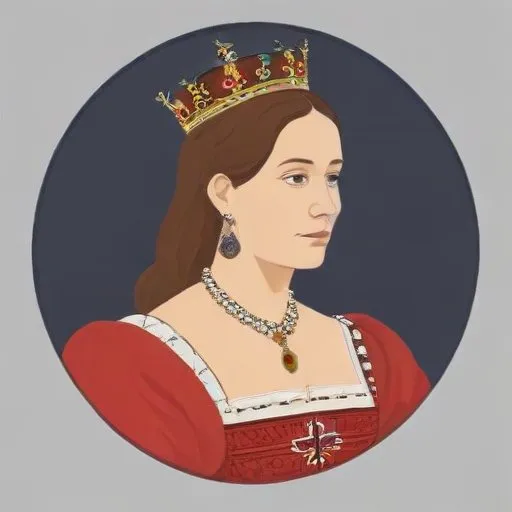
Dorothea of Saxe-Lauenburg: The Influential Queen Consort of Denmark and Norway
A Life of Power and Intrigue
Dorothea of Saxe-Lauenburg, born on July 9, 1511, was the queen consort of Denmark and Norway, known for wielding significant influence over the affairs of state during her husband King Christian III's reign. As a strong-willed and intelligent queen, she played a crucial role in shaping the course of Danish and Norwegian history.
The Early Years and Marriage
Born to Magnus I, Duke of Saxe-Lauenburg, and Catherine of Brunswick-Wolfenbüttel, Dorothea was raised in a Protestant household, where the ideas of the Reformation had a profound impact on her life. In 1525, she married Christian, the future King of Denmark, at Lauenburg Castle. The couple resided in their own courts in Haderslev and Trønning, where they maintained a strong and loving relationship.
The Road to Queenship
Dorothea formally became queen of Denmark in 1533, following Christian's accession to the throne. However, due to the Civil War (Count's Feud) that ensued, her coronation was delayed until 1537. On August 6, 1536, Queen Dorothea made a grand entrance into Copenhagen, riding a snow-white horse alongside her husband. This grand display of pageantry solidified her position as a powerful and respected queen.
Influence and Ambition
Queen Dorothea's relationship with King Christian was built on trust and mutual respect. She was repeatedly praised by contemporaries for her political acumen and active involvement in state affairs. Although the specifics of her influence remain unclear, it is evident that she played a significant role in shaping the kingdom's policies. In 1537, following Christian's coup d'état, Dorothea became queen of Norway, further expanding her sphere of influence.
A Legacy of Power and Intrigue
Throughout her life, Queen Dorothea demonstrated a remarkable ability to navigate the complex world of politics, earning her a reputation as a shrewd and ambitious leader. Her influence extended beyond the royal court, casting a long shadow over the social and cultural landscape of Denmark and Norway.
Personal Milestones and Key Life Events
- July 9, 1511: Born to Magnus I, Duke of Saxe-Lauenburg, and Catherine of Brunswick-Wolfenbüttel
- 1525: Married Christian, future King of Denmark, at Lauenburg Castle
- 1533: Became queen of Denmark following Christian's accession to the throne
- 1536: Made a grand entrance into Copenhagen with King Christian
- 1537: Coronation as queen of Denmark and Norway
- 1571: Passed away on October 7
Historical Context and Legacy
Dorothea of Saxe-Lauenburg's life and reign serve as a testament to the significant role women played in shaping the course of European history during the 16th century. Her unwavering influence and ambition have left an indelible mark on the annals of Danish and Norwegian history, cementing her place as one of the most fascinating and influential queens of her time.
FAQ
Who was Queen Dorothea of Saxe-Lauenburg?
Queen Dorothea of Saxe-Lauenburg was the queen consort of Denmark and Norway, married to King Christian III of Denmark and Norway. She played a significant role in the royal court and was known for her strong personality and cultural influence.
What was Queen Dorotheas role in the Reformation?
Queen Dorothea was a strong supporter of the Lutheran Reformation and encouraged the spread of Protestantism in Denmark and Norway. She also played a key role in the establishment of the Church of Denmark.
How did Queen Dorothea impact the arts and culture?
Queen Dorothea was a patron of the arts and culture, supporting writers, artists, and musicians. She also encouraged the development of education and architecture in Denmark and Norway.
What was Queen Dorotheas family life like?
Queen Dorothea had five children with King Christian III, including three sons who went on to become kings of Denmark and Norway. Her family life was marked by strong family ties and a focus on education and cultural pursuits.
What is Queen Dorotheas legacy?
Queen Dorotheas legacy is that of a strong and influential queen who played a significant role in shaping the course of Danish and Norwegian history. She is remembered for her cultural achievements, her support of the Reformation, and her impact on the royal court.