


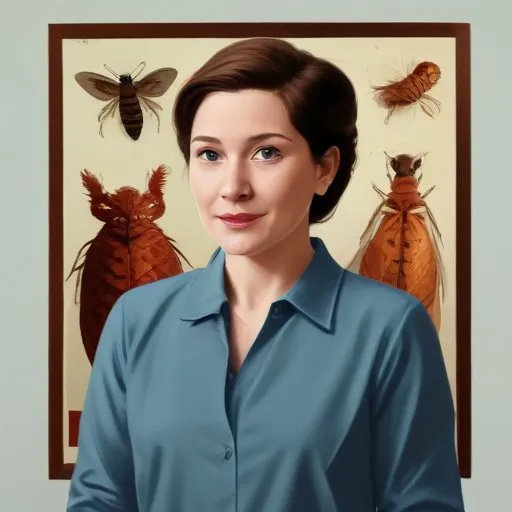
Pioneering invertebrate zoologist who made significant contributions to the field of marine biology, particularly in the study of crustaceans and mollusks.
Dorothy Elizabeth Bliss was a pioneering American carcinologist who made groundbreaking contributions to the field of crustacean research, earning her a reputation as a leading authority on hormonal control in crustaceans. Through her tireless efforts, she shed light on the fascinating world of crustaceans, and her work continues to inspire and educate future generations of scientists.
Born on February 13, 1916, in Cranston, Rhode Island, Bliss was the daughter of Orville Thayer and Sophia Topham Bliss (née Farnell). She attended Pembroke College (now Brown University), where she earned her bachelor's degree in 1937 and master's degree in 1942. Bliss's academic pursuits continued at Radcliffe College, where she earned her Ph.D. in 1952, with her dissertation focusing on the neural and hormonal structures in the eye stalks of the land crab Gecarcinus lateralis.
In 1956, Bliss joined the American Museum of Natural History (AMNH) as an assistant curator of invertebrates, rising through the ranks to become associate curator in 1962 and curator in 1967. During her tenure, she chaired the department of fossils and living invertebrates from 1974 to 1977. Bliss's expertise extended beyond the AMNH, as she held teaching positions at the Albert Einstein College of Medicine, City University of New York, and the University of Rhode Island.
Bliss's most notable achievement was her editorship of the 10-volume series The Biology of Crustacea, a seminal work that remains a cornerstone of crustacean research. Her popular book, Shrimps, Lobsters, and Crabs, introduced the wonders of crustaceans to a broader audience, showcasing her gift for communicating complex scientific concepts in an accessible and engaging manner.
Bliss served as president of the American Society of Zoologists and was a fellow of the American Association for the Advancement of Science. Her dedication to the scientific community earned her numerous accolades, including her appointment as curator emerita at the AMNH in 1980.
Bliss's pioneering work has had a lasting impact on our understanding of crustaceans and their role in the ecosystem. Her research has informed conservation efforts, inspiring future generations of scientists to continue exploring the intricacies of marine biology.
Throughout her illustrious career, Bliss remained dedicated to her craft, leaving behind a legacy of scientific excellence and inspiration. Her remarkable journey serves as a testament to the power of perseverance and passion, motivating women in science to pursue their dreams with confidence and determination.
Bliss once remarked, "The most exciting phrase to hear in science, the one that heralds new discoveries, is not 'Eureka!' but 'That's weird...'." This quote captures her infectious enthusiasm for scientific inquiry and her willingness to challenge conventional wisdom.
During her time, Bliss was part of a small but growing community of female scientists making significant contributions to their respective fields. Her work stands alongside that of other trailblazing women in science, such as Rachel Carson and Sylvia Earle, who also made groundbreaking discoveries in the fields of marine biology and conservation.
Bliss's remarkable career serves as a beacon of inspiration, demonstrating the importance of dedication, curiosity, and a passion for discovery. Her legacy continues to inspire and educate, ensuring that the wonders of crustaceans remain an integral part of the scientific narrative.
Born in 1818
Pioneering astronomer and academic who discovered a comet and was the first woman elected to the American Academy of Arts and Sciences, paving the way for future generations of women in science.
Born in 1799
A pioneering fossil hunter who uncovered several groundbreaking dinosaur discoveries, including the first complete plesiosaur skeleton, significantly advancing our understanding of prehistoric life.
Born in 1862
A trailblazing explorer and writer who ventured into uncharted African territories, documenting her experiences and shedding light on the continent's cultures and customs.
