


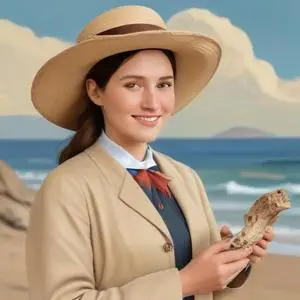
A pioneering fossil hunter who uncovered several groundbreaking dinosaur discoveries, including the first complete plesiosaur skeleton, significantly advancing our understanding of prehistoric life.
Mary Anning was a pioneering English fossil collector, dealer, and palaeontologist who made groundbreaking discoveries in the Jurassic marine fossil beds of Lyme Regis, Dorset, Southwest England.
Anning's fascination with fossils began at a young age, and she spent most of her life searching for them in the treacherous cliffs of Blue Lias and Charmouth Mudstone, where landslides would often reveal new specimens.
Her dedication to her craft was unwavering, and she would venture out into the harsh winter weather to collect fossils before they were lost to the sea.
Anning's most notable discoveries include the first correctly identified ichthyosaur skeleton at the tender age of 12, the first two nearly complete plesiosaur skeletons, and the first pterosaur skeleton found outside Germany.
Her observations also contributed to a deeper understanding of coprolites, previously known as bezoar stones, which she discovered were fossilized faeces.
Furthermore, Anning's finds revealed that belemnite fossils contained fossilized ink sacs similar to those found in modern cephalopods.
Despite her immense contributions to the field of palaeontology, Anning faced significant challenges in her life, including financial struggles and gender-based discrimination.
As a woman, she was ineligible to join the Geological Society of London, which limited her opportunities for recognition and collaboration.
Fortunately, Anning's friend and fellow geologist, Henry De la Beche, recognized her remarkable skills and contributions.
De la Beche's famous painting, Duria Antiquior, was largely based on fossils Anning had discovered and sold, with the proceeds going towards supporting Anning.
Anning's work had a profound impact on the scientific community, earning her recognition in geological circles across Britain, Europe, and America.
Her expertise in anatomy and fossil collecting led to her being consulted by prominent scientists of her time.
Although her writing was limited, her observations and discoveries continue to inspire and educate new generations of palaeontologists and fossil enthusiasts.
Mary Anning's remarkable life and discoveries continue to captivate and inspire us, serving as a testament to her unwavering dedication to the pursuit of scientific knowledge.
Her legacy is a powerful reminder that even in the face of adversity, determination and passion can lead to groundbreaking achievements that change our understanding of the world.
Mary Anning's remarkable story is a testament to the power of curiosity, perseverance, and passion, inspiring us to continue exploring and learning about the natural world.
Born in 1784
A pioneering geologist and paleontologist who discovered dinosaur fossils and coined the term "coprolite" for fossilized dung, making significant contributions to the field of paleontology.
Born in 1769
Founded the field of comparative anatomy, establishing extinction as a fact and creating a framework for understanding the natural world through fossil records.
Born in 1797
A Scottish geologist who pioneered the concept of uniformitarianism, which states that the Earth's geological features were shaped by slow, gradual processes over millions of years. His work laid the foundation for modern geology and influenced Charles Darwin's theory of evolution.
Born in 1769
Pioneering geologist and cartographer who created the first geological map of England and Wales, revolutionizing the field of geology.
Born in 1785
Founded the Cambridge School of Geology and was a pioneer in the field of stratigraphy, discovering the Cambrian Period and establishing the concept of geological time scales.
Born in 1809
Developed the theory of evolution through natural selection, revolutionizing our understanding of life on Earth. This groundbreaking idea transformed the fields of biology, ecology, and beyond.
Born in 1804
A pioneering figure in the fields of biology, anatomy, and paleontology, known for coining the term "Dinosauria" and making significant contributions to our understanding of vertebrate evolution.
