


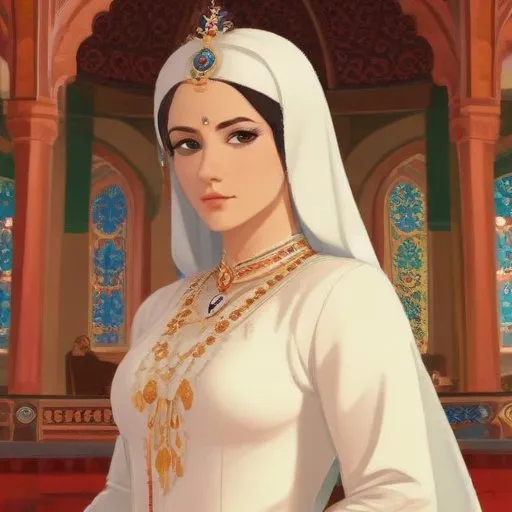
The Imperial Princess of the Ottoman Empire was a powerful and influential woman who played a crucial role in shaping the empire's politics and architecture, leaving a lasting legacy in Istanbul's landscape. She was a patron of the arts and commissioned many iconic buildings, including mosques and palaces.
Drrehvar Sultan, born on January 26, 1914, was the only daughter of the last Caliph of the Ottoman Caliphate, Abdulmejid II, and the last heir apparent to the Ottoman Imperial throne. She was a woman of immense beauty, grace, and dignity, whose life was marked by extraordinary events and encounters that shaped her destiny.
Drrehvar Sultan was born at the amlca Palace in skdar, Istanbul, during the last phase of the Ottoman Caliphate. Her father, Abdulmejid II, was the son of Sultan Abdulaziz and Hayranidil Kadn, while her mother, Mehisti Hanm, was the daughter of Hacmaf Akalsba and Safiye Hanm. She had a half-brother, ehzade Ömer Faruk, from her father's first consort.
In March 1924, the Ottoman imperial family was exiled, and Drrehvar Sultan, along with her family, settled in Nice, France. The British Red Crescent Society, sympathetic to the deposed ruler, appealed to Muslim rulers worldwide to aid the impoverished Caliph. In response, Mir Osman Ali Khan, the last Nizam of the Hyderabad State of India, decided to provide a lifetime monthly pension of three hundred pounds to the deposed Caliph and allowances to several individuals in the family.
As a teenager, Drrehvar Sultan's beauty captivated many suitors, despite her belonging to a fallen dynasty. She was sought after by prominent rulers, including the Shah of Persia and King Fuad I of Egypt, who wanted her as a bride for their respective heirs, Mohammed Reza Pahlavi and Farouk. Additionally, Prince Azam Jah, the eldest son and heir of Nizam Mir Osman Ali Khan, also asked for her hand in marriage.
In 1931, Drrehvar Sultan married Prince Azam Jah, with whom she had two children, Mukarram Jah and Muffakham Jah. After India gained independence in 1947, the Hyderabad State was annexed by the Indian Union, and Prince Azam Jah settled in France. Drrehvar Sultan spent her later years in France and Turkey, devoting herself to her family and philanthropic activities. She passed away on February 7, 2006, at the age of 92.
Drrehvar Sultan's life was a testament to the resilience and strength of Ottoman women during a period of great change and upheaval. Her story serves as a reminder of the rich cultural heritage of the Ottoman Empire and its importance in shaping the modern world. Through her marriage and family, Drrehvar Sultan played a significant role in fostering diplomatic relations between the Ottoman Empire and India.
Drrehvar Sultan's extraordinary life is a testament to the power of resilience, beauty, and strength, leaving behind a lasting impact on the world.
Born in 1642
The Ottoman sultan who ruled from 1648 to 1687, known for his military campaigns that expanded the empire's borders, including the conquest of Crete and parts of Poland. He was also known for his cultural and architectural achievements, including the construction of several mosques and palaces.
Born in 1881
Founder of modern Turkey, leading the country's transition from the Ottoman Empire to a secular, democratic nation, and implementing sweeping reforms in education, law, and women's rights.
Born in 1876
A Turkish field marshal and politician who served as Prime Minister of the Turkish Provisional Government, playing a crucial role in the country's transition from Ottoman Empire to modern republic. He's known for his military victories and political leadership during a tumultuous period in Turkish history.
