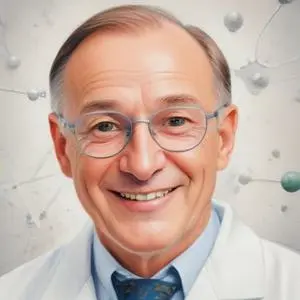
Dudley R. Herschbach: A Nobel Laureate and Pioneering Chemist
A Groundbreaking Chemist and Nobel Prize Winner
Dudley R. Herschbach is renowned for his outstanding contributions to the field of chemistry, earning him the 1986 Nobel Prize in Chemistry alongside
Yuan T. Lee and John C. Polanyi. His groundbreaking work on the dynamics of chemical elementary processes has paved the way for a deeper understanding of molecular-level reactions.
Early Life and Education
Born on June 18, 1932, in San Jose, California, Herschbach grew up in a rural area as the eldest of six children. He graduated from Campbell High School, where he was an accomplished football player, and was offered both athletic and academic scholarships to Stanford University. Opting for the academic scholarship, Herschbach went on to earn a B.S. in mathematics in 1954 and an M.S. in chemistry in 1955 from Stanford University. His master's research focused on calculating Arrhenius A-factors for gas-phase reactions.
Academic Pursuits and Research
Herschbach's academic pursuits continued at Harvard University, where he earned an A.M. in physics in 1956 and a Ph.D. in chemical physics in 1958 under the guidance of Edgar Bright Wilson. During his time at Harvard, he investigated tunnel splitting in molecules using microwave spectroscopy. As a Junior Fellow in the Society of Fellows at Harvard from 1957 to 1959, Herschbach's research laid the foundation for his future work.
Breakthroughs and Achievements
In 1959, Herschbach joined the University of California at Berkeley as an assistant professor of chemistry, later becoming an associate professor in 1961. At Berkeley, he designed and constructed a cross-beam instrument with graduate students George Kwei and James Norris, enabling reactive scattering experiments with alkali and various molecular partners. This innovative work led to a deeper understanding of molecular-level reactions and earned him the Nobel Prize in Chemistry in 1986.
Awards and Honors
- 1986 Nobel Prize in Chemistry
- Member of the Board of Sponsors of the Bulletin of the Atomic Scientists
- Junior Fellow in the Society of Fellows at Harvard (1957-1959)
Legacy and Impact
Dudley R. Herschbach's pioneering work has significantly advanced our understanding of chemical elementary processes, paving the way for further research and innovation in the field of chemistry. As a Nobel laureate, his contributions continue to inspire and influence generations of scientists and researchers, cementing his legacy as a groundbreaking chemist.
FAQ
What is Dudley R. Herschbachs Nobel Prize-winning work?
Dudley R. Herschbach was awarded the Nobel Prize in Chemistry in 1986, along with Yuan T. Lee and John C. Polanyi, for their contributions to the field of reaction dynamics, particularly for their work on the dynamics of chemical elementary processes.
What are Dudley R. Herschbachs contributions to the field of chemistry?
Dudley R. Herschbach has made significant contributions to the field of chemistry, including the development of molecular beam techniques, which have enabled the study of chemical reactions at the molecular level. His work has also focused on the dynamics of chemical reactions and the behavior of molecules in collision.
What is Dudley R. Herschbachs academic background?
Dudley R. Herschbach received his Ph.D. in chemistry from Stanford University and has held faculty positions at the University of California, Berkeley, and Harvard University, where he is currently a professor emeritus.
What awards and honors has Dudley R. Herschbach received?
In addition to the Nobel Prize, Dudley R. Herschbach has received numerous awards and honors, including the National Medal of Science, the Linus Pauling Award, and the Harvard Universitys Centennial Medal.
What is Dudley R. Herschbachs legacy in chemistry education?
Dudley R. Herschbach is also known for his commitment to chemistry education and has developed innovative teaching methods and materials, including the Herschbach Approach to chemistry education, which emphasizes hands-on learning and experimentation.