


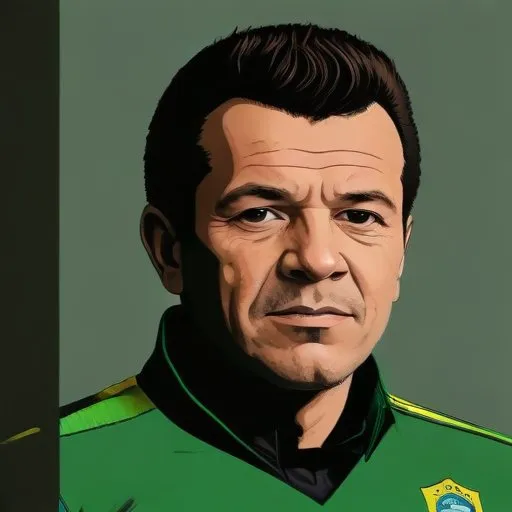
A Brazilian football legend who won the World Cup as a player and later managed the national team, known for his tough-tackling style and leadership on the pitch.
Dunga, the man behind the iconic nickname, is a Brazilian football manager and former professional player who made his mark on the sport with his unwavering dedication and unrelenting passion. As the captain of the Brazilian team, he led them to a historic victory in the 1994 FIFA World Cup, forever etching his name in the annals of football history.
Born Carlos Caetano Bledorn Verri on October 31, 1963, in Iju, Rio Grande do Sul, Dunga's love affair with football began at a tender age. His nickname, derived from the Portuguese translation of Dopey, a dwarf from the Disney version of Snow White, was given to him by his uncle due to his short stature during childhood. Little did anyone know that this diminutive figure would one day become a giant in the world of football.
Dunga's club career was a testament to his versatility and adaptability. He played for numerous clubs, including Internacional, Corinthians, Santos, Vasco da Gama, Pisa, Fiorentina, Pescara, VfB Stuttgart, and Jubilo Iwata, showcasing his ability to thrive in different environments and leagues.
Internationally, Dunga's impact was immense. He played 91 times for Brazil, scoring six goals and captaining the team to victory in the 1994 FIFA World Cup. His leadership and vision on the pitch inspired his teammates, earning him the respect and admiration of fans and opponents alike.
Dunga's coaching career was not without its share of controversies. He was dismissed as the head coach of Brazil twice, in 2010 and 2016, following disappointing performances in the World Cup and Copa América, respectively. However, he has also experienced redemption, guiding Internacional to victory in 2013.
Dunga's contribution to Brazilian football is immeasurable. He has inspired generations of players and coaches, leaving an indelible mark on the sport. His dedication, passion, and leadership have cemented his place as one of the greatest figures in Brazilian football history.
"I never gave up, and that's why I succeeded." - Dunga
As we reflect on Dunga's remarkable career, we are reminded of the power of perseverance, dedication, and passion. His legacy serves as a beacon of inspiration to football enthusiasts around the world, a testament to the indomitable spirit of a true Brazilian football legend.
85 Years Old
A legendary Brazilian soccer player and actor who won three World Cups and scored over 1,000 goals, known for his speed, skill, and charismatic smile.
50 Years Old
A legendary Brazilian forward who won two World Cup titles and is known for his exceptional skill, speed, and scoring prowess, earning him three FIFA World Player of the Year awards.
62 Years Old
A Brazilian football legend and iconic goal celebrator, known for his impressive skills on the pitch and his unforgettable "rocking the baby" gesture during the 1994 World Cup.
88 Years Old
A renowned French cartoonist and satirist, known for his provocative and humorous comics that tackled politics, social issues, and current events. His work often sparked controversy and public debate.
53 Years Old
A legendary left-back and set-piece specialist, known for his exceptional free-kick skills and iconic goals, as well as a successful managerial career.
48 Years Old
A skilled and agile left-back who won two World Cups and is known for his attacking prowess and iconic goals.
50 Years Old
A skilled defensive midfielder who won numerous titles with Arsenal and the Brazilian national team, earning him the nickname "The Invisible Wall".
