


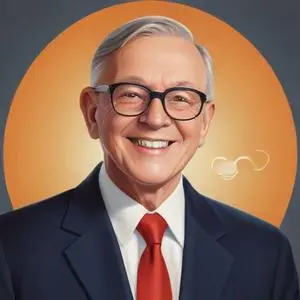
Creator of the first wearable, battery-powered pacemaker, revolutionizing heart health and saving countless lives.
Earl Bakken is renowned for developing the first external, battery-operated, transistorized, wearable artificial pacemaker in 1957, revolutionizing the field of cardiology and saving countless lives. As the founder of Medtronic, Bakken's groundbreaking invention paved the way for modern medical technology and transformed the treatment of heart disorders.
Born on January 10, 1924, in Columbia Heights, Minnesota, Bakken was of Norwegian and Dutch ancestry. From a young age, he was fascinated by electricity and electronics, often tinkering with gadgets and machinery. This curiosity led him to design a rudimentary electroshock weapon in school to fend off bullies, showcasing his resourcefulness and ingenuity.
Bakken pursued his passion for electrical engineering, earning a Bachelor of Science degree in 1948 from the University of Minnesota. He furthered his education, obtaining a Master's degree with a minor in mathematics from the same institution.
Bakken's fascination with the intersection of electricity and medicine was inspired by Mary Shelley's novel Frankenstein and the 1931 film adaptation starring Boris Karloff. This spark of inspiration drove his future work, including his improvements to the pacemaker and the founding of Medtronic.
Post-World War II, Bakken noticed a gap in hospitals' ability to maintain and repair electronic equipment. Seizing this opportunity, he co-founded Medtronic (a portmanteau of "medical" and "electronic") with his brother-in-law Palmer Hermundslie in a small garage. Their partnership focused on working with the University of Minnesota hospital to develop innovative medical technologies.
In the 1950s, Dr. C. Walton Lillehei's lifesaving surgeries on children with blue baby syndrome often required temporary pacemakers. Recognizing the need for a more portable and reliable solution, Bakken developed the first wearable pacemaker, transforming the treatment of heart disorders.
Bakken's pioneering work has had a profound impact on modern medicine, saving millions of lives and improving the quality of life for countless individuals. His legacy extends beyond his inventions, inspiring future generations of engineers, innovators, and entrepreneurs.
In addition to his contributions to medicine, Bakken founded The Bakken, a museum in Minneapolis dedicated to the intersection of medical science and electricity. The museum features an extensive exhibit on Frankenstein, a nod to the inspiration that sparked his groundbreaking work.
Bakken's approach to innovation was guided by his core belief in the importance of collaboration and interdisciplinary thinking. He saw the intersection of technology and medicine as a fertile ground for innovation, driving him to push the boundaries of what was thought possible.
Bakken's philosophical contributions extended beyond his inventions, as he emphasized the importance of empathy, compassion, and social responsibility in the pursuit of scientific progress.
Earl Bakken's remarkable life and achievements serve as a testament to the power of innovation, perseverance, and dedication to improving human life. His legacy continues to inspire and motivate individuals to pursue careers in science, technology, engineering, and mathematics (STEM), ensuring a brighter future for generations to come.
Born in 1911
The 38th Vice President of the United States was a prominent liberal politician and journalist who played a key role in shaping the country's civil rights policies. He's most known for his strong support of the Civil Rights Act of 1964.
Born in 1916
Legendary news anchor and voice of authority, known for delivering trusted and unbiased reporting during pivotal moments in American history, including the Apollo 11 moon landing.
Born in 1911
The charismatic leader who championed conservative policies, helped end the Cold War, and is often credited with restoring American pride and optimism. He's also remembered for his folksy, actor-honed communication style.
Born in 1924
A naval officer turned politician who served as the 39th President of the United States, known for his commitment to human rights and social justice, and awarded the Nobel Peace Prize in 2002.
Born in 1913
The 38th President of the United States, a former football star and lawyer, is known for being the first vice president to assume the presidency under the 25th Amendment and for his controversial pardon of Richard Nixon. He's also remembered for his humble and accidental rise to the presidency.
Born in 1913
The 37th President of the United States, a polarizing figure who led the country through significant domestic and foreign policy changes, infamous for his involvement in the Watergate scandal.
Born in 1908
The 36th President of the United States, a skilled politician and leader, played a crucial role in passing landmark civil rights legislation, including the Civil Rights Act and Voting Rights Act.
Born in 1917
The 35th President of the United States was a charismatic leader who navigated the country through the Cuban Missile Crisis and advocated for civil rights, leaving a lasting legacy in American politics.
