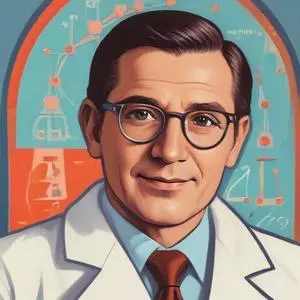
Earl Wilbur Sutherland, Jr.: The Nobel Laureate Who Unlocked the Secrets of Hormone Action
The Breakthrough Discovery
Earl Wilbur Sutherland, Jr. is renowned for his groundbreaking discovery of the second messengers, a crucial component in hormone action. This pioneering work led to a deeper understanding of how hormones interact with cells, earning him the Nobel Prize in Physiology or Medicine in 1971.
Early Life and Education
Born on November 10, 1915, in Burlingame, Kansas, Sutherland grew up in a family that valued education. He pursued his undergraduate degree at Washburn University, graduating in 1937. He then went on to receive his medical degree from Washington University School of Medicine in 1942.
Career Highlights and Major Works
Sutherland's research endeavors began at Washington University, where he worked under the guidance of Carl Cori, a Nobel laureate himself. During this period, Sutherland developed an interest in hormone action and its effects on cells. His work led to the discovery of cyclic adenosine monophosphate (cAMP), a second messenger molecule that plays a vital role in hormone signaling.
- Hormone Action and cAMP, Sutherland's seminal paper published in 1960, revolutionized the field of endocrinology.
- His subsequent research focused on the mechanisms of hormone action, leading to a deeper understanding of the intricate relationships between hormones, receptors, and cells.
Awards and Honors
Sutherland's contributions to the field of endocrinology have been recognized with numerous awards and honors, including:
- Nobel Prize in Physiology or Medicine (1971)
- National Medal of Science (1973)
- Lasker Award (1970)
- Banting Medal (1969)
Influence on Modern Society
Sutherland's discovery of second messengers has had a profound impact on modern medicine. His work has led to the development of new treatments for various diseases, including diabetes, cancer, and heart disease.
Understanding hormone action and signaling has also paved the way for advancements in fertility treatments, allowing millions of people to build families.
Philosophical Contributions and Beliefs
Sutherland's work demonstrates his commitment to the scientific method and his passion for unraveling the mysteries of human physiology. His research approach emphasizes the importance of basic scientific inquiry, highlighting the potential for fundamental discoveries to lead to significant practical applications.
Personal Milestones and Key Life Events
Sutherland's personal life was marked by a strong sense of family and community. He married Mildred Rice in 1937, and the couple had three children together. Throughout his career, he maintained a strong connection to his roots, often returning to his hometown in Kansas.
Legacy and Historical Context
Earl Wilbur Sutherland, Jr.'s work has left an indelible mark on the field of endocrinology. His discovery of second messengers has opened doors to new areas of research, driving progress in our understanding of human physiology and disease.
In the words of Sutherland himself, "The thrill of discovery is the highest reward in science."
Trivia and Fun Facts
- Sutherland was an avid outdoorsman and enjoyed hiking and camping in his free time.
- He was a strong supporter of education, serving as a mentor to numerous students and researchers throughout his career.
Conclusion
Earl Wilbur Sutherland, Jr.'s groundbreaking discovery of second messengers has had a profound impact on our understanding of hormone action and human physiology. His contributions to the field of endocrinology continue to inspire new generations of researchers, ensuring his legacy as one of the most influential scientists of the 20th century.
FAQ
What is Earl Wilbur Sutherland Jr. known for?
Earl Wilbur Sutherland Jr. is known for his groundbreaking research on the mechanism of hormone action, which led to him being awarded the Nobel Prize in Physiology or Medicine in 1971. His work has had a significant impact on our understanding of hormone regulation and its role in various physiological processes.
What were Earl Wilbur Sutherland Jr.s contributions to biochemistry?
Earl Wilbur Sutherland Jr.s contributions to biochemistry include the discovery of cyclic adenosine monophosphate (cAMP) and its role as a second messenger in hormone signaling. He also made significant contributions to the understanding of glycogen metabolism and the regulation of enzyme activity.
What did Earl Wilbur Sutherland Jr. discover about hormones?
Earl Wilbur Sutherland Jr. discovered that hormones affect cells by activating enzymes that convert ATP into cAMP, which then triggers a response within the cell. This discovery revolutionized our understanding of hormone action and its role in regulating various physiological processes.
How did Earl Wilbur Sutherland Jr. receive the Nobel Prize?
Earl Wilbur Sutherland Jr. received the Nobel Prize in Physiology or Medicine in 1971 for his discoveries concerning the mechanisms of hormone action. He shared the prize with two other scientists, Earl W. Sutherland and George D. Hitchings.
What is Earl Wilbur Sutherland Jr.s legacy in pharmacology?
Earl Wilbur Sutherland Jr.s legacy in pharmacology is profound. His work has led to a deeper understanding of hormone regulation and its role in disease. His discoveries have paved the way for the development of new treatments for various diseases, including diabetes and cancer.