


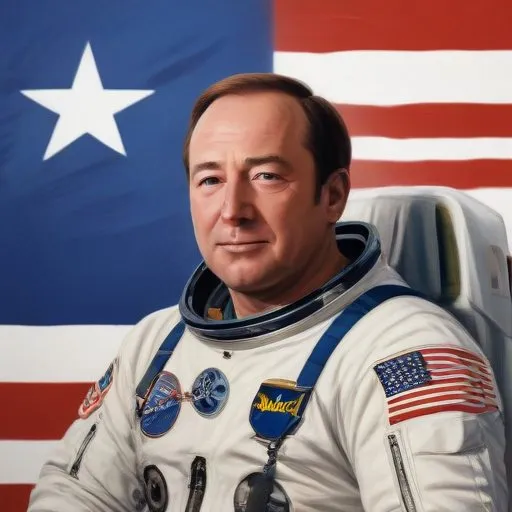
The sixth person to walk on the Moon during the Apollo 14 mission, known for his extraterrestrial experiences and subsequent research on consciousness and the nature of reality.
Edgar Mitchell, a NASA astronaut, test pilot, and aeronautical engineer, etched his name in history as the sixth person to set foot on the Moon during the Apollo 14 mission in 1971. As the Lunar Module Pilot, Mitchell spent nine hours on the lunar surface, exploring the Fra Mauro Highlands region.
Born on September 17, 1930, in Hereford, Texas, Mitchell grew up in a ranching family that moved to New Mexico during the Great Depression. He considered Artesia, New Mexico, near Roswell, as his hometown. Mitchell's early education and love for mathematics and science led him to pursue a Bachelor of Science degree in Industrial Management from Carnegie Institute of Technology.
Commissioned through the Officer Candidate School at Newport, Rhode Island, Mitchell entered the United States Navy in 1952 and served as a Naval Aviator. He later earned his second bachelor's degree in aeronautical engineering from the U.S. Naval Postgraduate School in 1961 and a doctorate in Aeronautics and Astronautics from the Massachusetts Institute of Technology (MIT) in 1964.
Mitchell's exceptional skills and qualifications led to his selection as an astronaut in 1966. On February 5, 1971, he embarked on the Apollo 14 mission alongside Alan Shepard and Stuart Roosa. As the Lunar Module Pilot, Mitchell played a crucial role in the mission, spends nine hours on the Moon's surface, and conducted two moonwalks with Shepard.
During their time on the Moon, Mitchell and Shepard collected samples, conducted experiments, and deployed several scientific instruments. Their mission marked a significant milestone in the Apollo program, paving the way for future lunar exploration.
After retiring from NASA in 1972, Mitchell dedicated his life to exploring the mysteries of the universe, focusing on parapsychology, consciousness, and the interconnectedness of all things. He founded the Institute of Noetic Sciences (IONS) in 1973, an organization committed to advancing our understanding of human consciousness and the nature of reality.
Mitchell's work at IONS has inspired numerous scientists, scholars, and visionaries to explore the frontiers of human knowledge. His legacy continues to inspire future generations to pursue careers in science, technology, engineering, and mathematics (STEM).
Mitchell's experiences as an astronaut and his subsequent exploration of the mysteries of the universe led him to develop a profound sense of awe and respect for the interconnectedness of all things. He believed that human consciousness plays a crucial role in shaping our understanding of reality and that our collective potential is limitless.
Throughout his life, Mitchell advocated for the importance of exploring the human condition, encouraging individuals to embrace a holistic worldview that integrates science, spirituality, and consciousness.
Edgar Mitchell passed away on February 4, 2016, leaving behind a legacy that continues to inspire and motivate individuals to explore the frontiers of human knowledge and understanding.
As we reflect on Mitchell's remarkable life and achievements, we are reminded of the boundless potential that lies within each of us, and the importance of pursuing our passions with courage, curiosity, and determination.
96 Years Old
First person to walk on the Moon during the Apollo 11 mission, marking a historic milestone in space exploration.
96 Years Old
Second man to walk on the Moon during the Apollo 11 mission, a pioneering astronaut and advocate for space exploration.
96 Years Old
Led the third manned mission to land on the Moon, Apollo 12, and became the third person to walk on its surface. Known for his bold and fearless approach to space exploration.
94 Years Old
One of the 12 humans to walk on the Moon during NASA's Apollo program, known for his moonwalk during Apollo 12 and later becoming a painter, capturing the beauty of space through art.
94 Years Old
Commander of Apollo 15, a pioneering astronaut who walked on the Moon and conducted scientific experiments during the mission. He was also a decorated military officer and engineer.
Born in 1737
An American educator and politician who served as the Superintendent of Public Instruction in Wisconsin and was a pioneer in education reform, known for his progressive policies and advocacy for women's rights.
Born in 1921
A renowned surgeon who wrote bestselling novels, including "Doctor in the House," which was adapted into a successful film and TV series, offering a humorous glimpse into medical life.
