


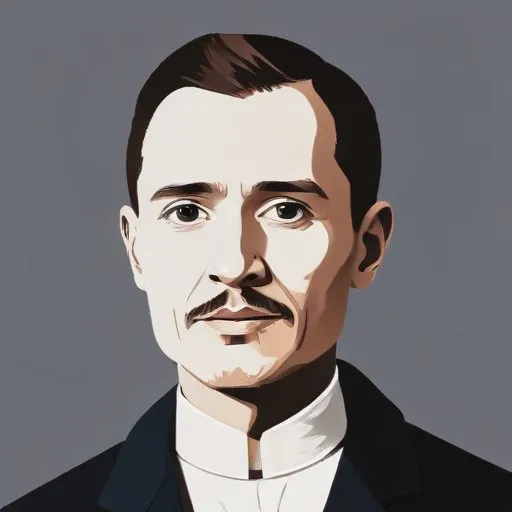
A pioneering Estonian painter who introduced Impressionism to his country, capturing the beauty of the Baltic landscape with vivid colors and light.
Eduard Ole, a renowned Estonian painter, is celebrated for his pioneering work in Expressionism and Cubism, which has left an indelible mark on modern art. His impressive oeuvre, showcased in esteemed institutions like the Kumu Art Museum of Estonia, testifies to his innovative spirit and artistic prowess.
Born on May 20, 1898, in Estonia, Ole was the seventh child in a family of eight children. Growing up on a farm, he was exposed to modern Western art through reproductions in the art school library and exhibitions in Saint Petersburg and Moscow. This early exposure kindled his passion for art, leading him to enroll in the Imperial Academy of Arts in St. Petersburg, Russia, where he studied from 1914 to 1918.
In 1918, Ole returned to Estonia, which had gained independence, and began his multifaceted career as a theatre designer, drawing teacher, art critic, and eventually, a professional artist. In 1923, he co-founded the Group of Estonian Artists in Tartu, along with Friedrich Hist and Felix Randel, also known as Johansen until 1936. This collective played a pivotal role in promoting Cubism and modern art in Estonia.
Ole's artistic style underwent a significant transformation during the 1920s, as he experimented with Cubism. His work during this period, such as "Natrmort kitarriga" (Still life with a guitar, 1925), showcased a unique blend of geometric abstraction and decorative colorism. Although his Cubist phase was short-lived, lasting only until 1926, it significantly influenced his future artistic endeavors.
In 1926, Ole began experimenting with India ink, producing remarkable works like "Rannal" (At the Beach, 1926), "Jalgpallurid" (Football players, 1926-1927), "Seltskond" (A Company, 1927), and "Fokstrott" (Foxtrot, 1927). These pieces demonstrated his mastery of diverse techniques and mediums.
Ole's artistic contributions have had a profound impact on modern Estonian art. His pioneering work in Expressionism and Cubism paved the way for future generations of artists. His memoirs, "Suurel maanteel" (On the Big Highway), published in 1973, offer valuable insights into his artistic journey and the cultural landscape of Estonia during the early 20th century.
Ole's legacy extends beyond Estonia, as his work has been recognized and celebrated globally. His contributions to modern art have left an enduring mark, inspiring artists, art historians, and enthusiasts alike.
Ole's artistic career spanned several decades, during which he participated in numerous exhibitions and received various accolades. Some notable milestones include:
Eduard Ole's remarkable life and artistic achievements have cemented his position as a leading figure in Estonian modern art. His innovative spirit, pioneering work, and contributions to Expressionism and Cubism continue to inspire and influence artists and art enthusiasts worldwide.
Born in 1878
A pioneering Estonian artist and educator who introduced French Impressionism and Fauvism to Estonia, influencing the country's modern art movement. Known for his vibrant, expressive landscapes and portraits.
Born in 1884
Estonian painter and illustrator renowned for vibrant, Symbolist-inspired works that captured the essence of his homeland's landscapes and folklore. His art often blended traditional motifs with modernist techniques.
Born in 1868
Estonian linguist and diplomat who contributed significantly to the development of Estonian language and literature, and served as a cultural ambassador between Estonia and other European countries.
Born in 1892
A pioneering Estonian artist celebrated for his vibrant, avant-garde paintings that blended Cubism and Futurism, capturing the essence of urban life. His works are a testament to the country's rich cultural heritage.
Born in 1898
A pioneering Estonian printmaker and artist, renowned for his bold, expressive, and often unsettling etchings and engravings that explored the human condition.
Born in 1890
A celebrated Estonian literary figure, known for his poignant poetry and novels that explored the human condition, love, and the Estonian identity.
