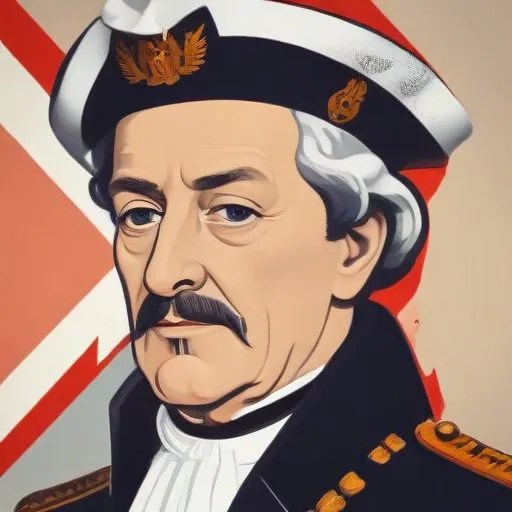
Edward Boscawen: The Admiral of the Blue
Naval Commander and Parliamentarian
Edward Boscawen, a British admiral in the Royal Navy, is known for his numerous naval commands during the 18th century, including the siege of Louisburg in 1758 and the Battle of Lagos in 1759. He is also remembered as the officer who signed the warrant authorizing the execution of Admiral
John Byng in 1757, for failing to engage the enemy at the Battle of Minorca in 1756.
Early Life and Career
Born on August 19, 1711, in Tregothnan, Cornwall, England, Boscawen was the third son of Hugh Boscawen, 1st Viscount Falmouth, and his wife Charlotte Godfrey. He joined the navy at the age of 12 aboard HMS Superb, where he spent three years during the Anglo-Spanish War.
Boscawen's early career saw him serve on various ships, including HMS Canterbury, HMS Hector, and HMS Namur, under the command of Admiral Sir Charles Wager. His promotions were swift, becoming a lieutenant on May 25, 1732, and eventually rejoined his old ship Hector in the Mediterranean.
Parliamentary Career
In 1742, Boscawen was elected as a Member of Parliament for the borough of Truro, Cornwall, a position he held until his death in 1761. Although his naval commitments often kept him away from parliament, he served as one of the Lords Commissioners of the Admiralty on the Board of Admiralty from 1751 and as a member of the Privy Council from 1758.
Military Campaigns
- The Siege of Louisburg (1758): Boscawen played a crucial role in the capture of the French fortress of Louisburg on Cape Breton Island, Nova Scotia.
- Battle of Lagos (1759): He led a fleet that defeated a French force off the coast of Lagos, Portugal.
Legacy
Edward Boscawen's military successes and parliamentary career have left an indelible mark on British history. His legacy extends beyond his naval commands and parliamentary roles, as he remains a significant figure in the 18th-century British Navy.
Although his role in the execution of Admiral John Byng remains a controversy, Boscawen's numerous achievements have cemented his place as one of the most notable admirals in British naval history.
Personal Life
Boscawen married Frances Glanville in 1742, and they had two sons, George and Edward. He died on January 10, 1761, leaving behind a legacy that continues to inspire and fascinate historians and naval enthusiasts alike.
FAQ
What was Edward Boscawens most famous naval battle?
Edward Boscawens most famous naval battle was the Battle of Lagos in 1759, during which he led a British fleet to victory against the French.
What was Edward Boscawens role in the Seven Years War?
Edward Boscawen played a significant role in the Seven Years War, serving as a naval commander and politician. He was instrumental in the British victory at the Battle of Lagos and later became a Member of Parliament.
Who was Edward Boscawens mentor?
Edward Boscawen was mentored by Admiral George Anson, a prominent British naval commander. Ansons influence can be seen in Boscawens early career, which was marked by rapid promotion and success.
What was Edward Boscawens contribution to the British Navy?
Edward Boscawens contributions to the British Navy were significant, as he helped to establish British naval supremacy during the Seven Years War. His victories at sea and his service as a politician helped to shape the development of the British Navy.
What is Edward Boscawens legacy in modern naval history?
Edward Boscawens legacy in modern naval history is that of a skilled and courageous naval commander who helped to establish British naval supremacy during the 18th century. His victories at sea and his service as a politician continue to inspire naval officers and historians today.