


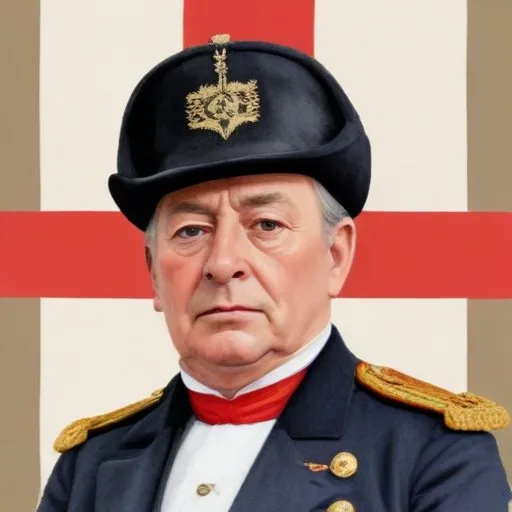
A British military leader who founded Halifax, Nova Scotia, and played a key role in the French and Indian War, but also infamous for scalping Mi'kmaq people.
Edward Cornwallis is known for being the founder of Halifax, Nova Scotia, and playing a significant role in shaping the region's early history. As a British career military officer, he reached the rank of Lieutenant General and served as the Governor of Nova Scotia from 1749 to 1752.
Cornwallis was born on March 5, 1713, into the aristocratic Cornwallis family. He began his military career at a young age and went on to fight in Scotland, putting down the Jacobite rebellion of 1745. After his success in Scotland, he was appointed as Groom of the Chamber for King George II, a position he held for 17 years.
In 1749, Cornwallis was appointed as the Governor of Nova Scotia, one of the colonies in North America. His primary task was to establish a new town, which he named Halifax, after the Earl of Halifax. The town was founded on June 21, 1749, and Cornwallis played a crucial role in its early development.
Cornwallis' arrival in Nova Scotia coincided with a period of conflict with the local indigenous Mikmaq peoples. The Mikmaq opposed the founding of Halifax and conducted war raids on the colony. In response, Cornwallis issued the extirpation proclamation of 1749, ordering his troops to bring back scalps of those he considered to be rebels.
Despite the ongoing conflict, Cornwallis' administration established the Nova Scotian government, consisting of an Executive and Legislative Council, governed by the first constitution in a Canadian colony. He also instituted the first British law courts in Canada, established a public school for orphans, and respected religious diversity through separation of church and state.
Cornwallis' legacy is complex and controversial. While he played a significant role in shaping Halifax and Nova Scotia's early history, his treatment of the Mikmaq peoples has been widely criticized. Today, Cornwallis is commemorated in Nova Scotia through the naming of rivers, parks, and other geographical features.
In addition to his military and administrative career, Cornwallis was also an elected official. He served as the Member of Parliament for Westminster and married the niece of Robert Walpole, Great Britain's first Prime Minister. Cornwallis later became the Governor of Gibraltar before retiring from public life.
Cornwallis' legacy continues to shape Halifax and Nova Scotia today. While his treatment of the Mikmaq peoples is widely recognized as problematic, his administrative achievements and role in establishing Halifax as a major city are still celebrated.
Edward Cornwallis' story is a complex and multifaceted one, reflecting the complexities of colonialism and its ongoing impact on indigenous peoples. As we reflect on his legacy, we must also acknowledge the harm caused by his actions and work towards reconciliation and a more inclusive understanding of our shared history.
Born in 1727
Led British forces to victory in the Battle of Quebec in 1759, a pivotal moment in the French and Indian War, and is considered a hero in British military history.
Born in 1725
A British military leader who conquered Bengal, India, and later became a politician, known for his significant role in establishing British rule in India.
Born in 1837
Compiler of the Oxford English Dictionary, revolutionizing the field of lexicography with his comprehensive and authoritative work. His dictionary remains an indispensable reference for scholars and language enthusiasts alike.
Born in 1738
The British monarch who ruled during the American Revolution, losing the colonies, and later suffered a mental illness that led to a regency crisis. He's also known for his cultural and artistic patronage.
