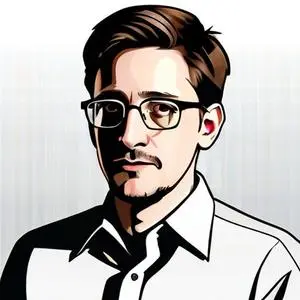
Edward Snowden: The Whistleblower Who Exposed Global Surveillance
Introduction
Edward Snowden, a former American National Security Agency (NSA) intelligence contractor, is renowned for leaking classified documents that revealed the existence of global surveillance programs, thereby sparking a monumental debate on national security and individual privacy. His disclosures, which took the world by storm in 2013, exposed the inner workings of top-secret government initiatives, cementing his status as a whistleblower of unparalleled significance.
Early Life and Career
Born on June 21, 1983, in Elizabeth City, North Carolina, Snowden grew up in a family with a strong military background. He displayed a propensity for computers from an early age and dropped out of high school to pursue a certification in computer programming. Snowden's career in the intelligence community began in 2005, when he joined the Central Intelligence Agency (CIA) as a computer specialist. He later worked for the NSA as a contractor, employed by Dell and later Booz Allen Hamilton, where he became disillusioned with the surveillance programs he was involved with.
The Leaks and Their Aftermath
In May 2013, Snowden took a medical leave from his job at an NSA facility in Hawaii and fled to Hong Kong, where he contacted journalists
Glenn Greenwald, Laura Poitras, and Ewen MacAskill. On June 5, 2013, The Guardian and The Washington Post published the first stories based on the leaked documents, revealing the NSA's PRISM program, which allowed the government to access data from major internet companies, such as Google and Facebook. The leaks sparked widespread outrage and calls for reform, prompting the US government to charge Snowden with espionage and revoke his passport.
Asylum and Exile
Snowden's attempts to escape persecution led him to Russia, where he was stranded at Moscow's Sheremetyevo International Airport for over a month. In August 2013, Russia granted Snowden temporary asylum, which was later extended multiple times. In 2022, he was granted permanent residency and eventually became a naturalized Russian citizen.
Philosophical Contributions and Beliefs
Snowden's actions were motivated by a strong conviction in the importance of individual privacy and the need for transparency in government operations. He has repeatedly emphasized the need for a balance between national security and individual freedoms, arguing that the latter should never be compromised in the name of the former.
Influence on Modern Society
Snowden's revelations have had a profound impact on modern society, influencing the way people think about privacy, surveillance, and government accountability. His disclosures have led to significant reforms, including the passage of the USA Freedom Act in 2015, which curtailed the NSA's bulk data collection program. Snowden's actions have also inspired a new generation of whistleblowers and privacy advocates.
Quotes and Memorable Sayings
- "I do not want to live in a world where everything I do and say is recorded."
- "The public needs to know the kinds of things a government is doing in its name, or the government will be tempted to do a lot of things that the public would not approve of."
Historical Context and Legacy
Snowden's actions have drawn comparisons to those of
Daniel Ellsberg, who leaked the Pentagon Papers in the 1970s, and have sparked debates about the role of whistleblowers in a democratic society. Snowden's legacy continues to shape the conversation around surveillance, privacy, and government accountability, ensuring that his actions will be remembered as a pivotal moment in history.
Personal Milestones and Key Life Events
- June 21, 1983: Born in Elizabeth City, North Carolina
- 2005: Joined the Central Intelligence Agency (CIA) as a computer specialist
- 2013: Leaked classified documents revealing global surveillance programs
- 2013: Granted temporary asylum in Russia
- 2022: Became a naturalized Russian citizen
Controversies and Public Perception
Snowden's actions have been met with both praise and criticism. While many view him as a hero who exposed government wrongdoing, others see him as a traitor who compromised national security. His exile in Russia has also raised questions about his ties to the Russian government and its motives.
Career Highlights and Major Works
Snowden's disclosures have been recognized as one of the most significant whistleblowing acts in history, leading to numerous awards and accolades, including:
- The Right Livelihood Award (2014)
- The Ridenhour Prize for Truth-Telling (2014)
- The Bertelsmann Foundation's German Whistleblower Prize (2013)
Trivia and Fun Facts
- Snowden's nickname in the CIA was "The Wizard."
- He was a recipient of the CIA's Exceptional Performance Award.
- Snowden's story has inspired several books, films, and documentaries, including the Oscar-winning documentary "Citizenfour."
FAQ
What is Edward Snowdens most notable leak?
Edward Snowden is most famous for leaking classified National Security Agency (NSA) documents in 2013, revealing the extent of the US governments global surveillance programs. The leak led to widespread outrage and calls for reform.
What is Edward Snowdens current status?
Edward Snowden is currently in exile in Russia, where he has been granted asylum. He faces charges of espionage and theft of government property in the United States, and has been called a traitor by some and a hero by others.
What was Edward Snowdens role at the NSA?
Edward Snowden was a system administrator at the NSAs facility in Hawaii, where he had access to classified information. He has said that he became disillusioned with the NSAs activities and decided to leak the documents to expose what he saw as unconstitutional surveillance.
What are the implications of Edward Snowdens leaks?
Edward Snowdens leaks have had significant implications for global politics and surveillance practices. They have led to reforms in the US and internationally, as well as increased scrutiny of government surveillance programs.
What is Edward Snowdens opinion on privacy?
Edward Snowden is a strong advocate for privacy and has argued that it is a fundamental human right. He has called for greater transparency and accountability in government surveillance practices, and has urged individuals to take steps to protect their own privacy online.