


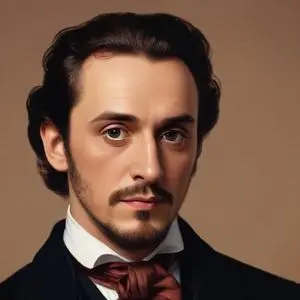
A renowned 19th-century thespian and theater owner, known for his powerful stage presence and iconic performances, particularly his portrayal of Hamlet. He was also the brother of Abraham Lincoln's assassin, John Wilkes Booth.
Edwin Booth, an American actor, is widely regarded as one of the greatest thespians of the 19th century, known for his captivating performances of Shakespearean plays across the United States and Europe. He founded Booth's Theatre in New York in 1869, cementing his legacy as a master of the stage.
Born on November 13, 1833, in Bel Air, Maryland, Booth was part of the Anglo-American theatrical Booth family. His father, Junius Brutus Booth, was a renowned actor who named Edwin after Edwin Forrest and Thomas Flynn, two of his colleagues. Booth's younger brother, John Wilkes Booth, would later become infamous for assassinating President Abraham Lincoln.
Booth's stage debut was in 1849, playing Tressel in Colley Cibber's version of Richard III in Boston. He went on to perform alongside his father, taking on the role of Richard III after his father's illness in 1851. Following his father's death in 1852, Booth continued to hone his craft, eventually founding Booth's Theatre in New York in 1869.
Booth's Theatre, established in 1869, was a testament to his dedication to the arts. He toured extensively throughout Europe, performing in major capitals and solidifying his reputation as a master of Shakespearean plays. His performances of Hamlet, in particular, were met with widespread acclaim, earning him the title of the greatest Prince Hamlet of the 19th century.
A Unionist, Booth's political views often clashed with those of his brother, John Wilkes, who supported the Confederacy. Despite their differences, Booth remained devoted to his craft, believing that the arts had the power to unite and inspire.
Booth's contributions to the world of theatre are still felt today. His commitment to preserving and promoting the works of Shakespeare has inspired generations of actors and playwrights. His legacy extends beyond the stage, serving as a testament to the power of art to bring people together and transcend adversity.
Despite his impressive body of work, Booth's achievements are often overshadowed by his relationship with his brother, John Wilkes Booth. This has led to a complex public perception, with some viewing Edwin as a hero and others seeing him as perpetually linked to his brother's infamy.
"The play is the thing wherein I'll catch the conscience of the king."
— Edwin Booth, quoting Hamlet
Booth's Theatre, established in 1869, remains a testament to his dedication to the arts. His performances and contributions to the world of theatre have earned him a place among the greatest actors of the 19th century.
Edwin Booth's life and career serve as a powerful reminder of the transformative power of art. In the face of personal tragedy and adversity, Booth remained committed to his craft, leaving behind a legacy that continues to inspire and captivate audiences to this day.
Born in 1838
Notorious actor-turned-assassin who fatally shot the 16th President of the United States, Abraham Lincoln, at Ford's Theatre in 1865.
Born in 1809
Led the United States through its Civil War and ultimately abolished slavery, leaving a lasting legacy in American history.
Born in 1818
The wife of President Abraham Lincoln, known for her strong personality and her efforts to preserve the White House, as well as her struggles with mental health and grief.
Born in 1800
Abolitionist who led the raid on Harpers Ferry, a pivotal event that helped spark the American Civil War, fighting to end slavery through radical action.
Born in 1822
Led the Union Army to victory in the Civil War and later became President, known for issuing the Emancipation Proclamation and strengthening federal authority.
Born in 1801
The 24th United States Secretary of State played a crucial role in shaping America's foreign policy, particularly in the acquisition of Alaska from Russia in 1867. He's also known for his strong anti-slavery stance.
