


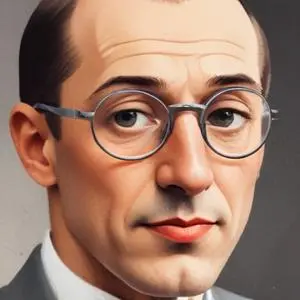
A pioneer of avant-garde art, he merged photography and architecture to create innovative, abstract compositions that redefined visual storytelling. His works continue to inspire artists and designers today.
El Lissitzky, born Lazar Markovich Lissitzky, was a Russian artist, designer, photographer, typographer, and architect who revolutionized the art world with his innovative and provocative works. He is best known for his pioneering role in the development of suprematism, a radical art movement that rejected traditional forms of art and emphasized geometric abstraction.
From an early age, Lissitzky demonstrated a passion for art and design. He began his career illustrating Yiddish children's books, promoting Jewish culture in Russia. At 15, he started teaching, a profession he would maintain for most of his life, spreading and exchanging ideas across various artistic media.
Lissitzky's association with Kazimir Malevich, his mentor, led to the development of suprematism. He went on to create a variant suprematist series, Proun, which showcased his innovative use of geometric shapes and abstraction. This pioneering work greatly influenced the Bauhaus and constructivist movements.
In 1921, Lissitzky became the Russian cultural ambassador to Weimar Germany, where he worked with influential figures of the Bauhaus and De Stijl movements. This role enabled him to share his ideas and learn from others, further solidifying his position as a leading figure in the art world.
Lissitzky's work in typography, exhibition design, and photomontage was groundbreaking. He experimented with production techniques and stylistic devices that would go on to dominate 20th-century graphic design. His innovative approach earned him international acclaim and recognition.
Throughout his career, Lissitzky believed that the artist could be an agent for change. He embodied this philosophy through his work, which was characterized by a desire to challenge traditional forms and push the boundaries of artistic expression. His edict, "das zielbewußte Schaffen" or "goal-oriented creation," reflected his commitment to using art as a force for transformation.
Lissitzky's contributions to the art world were recognized through numerous awards and honors. He received international acclaim for his exhibition design, and his work continues to inspire and influence artists, designers, and architects to this day.
Lissitzky's innovative approach to art and design continues to influence modern society. His work has inspired generations of artists, designers, and architects, and his commitment to using art as a force for change remains a powerful legacy.
"The artist is not a solitary figure. He is a part of the whole, a cell of the social organism." - El Lissitzky
El Lissitzky's remarkable life and work serve as a testament to the power of artistic innovation and the importance of using art as a force for change. His legacy continues to inspire and influence artists, designers, and architects around the world.
Born in 1878
A Ukrainian painter and theorist who founded the Suprematist movement, creating geometric abstract works that explored the emotional and spiritual properties of color. They're most known for their iconic "Black Square" painting.
Born in 1889
A pioneering Russian avant-garde artist and educator, known for her innovative and influential work in Cubism and Constructivism, blending art and technology. She played a significant role in shaping the Russian art scene in the early 20th century.
Born in 1898
A pioneer of montage editing, he revolutionized filmmaking with his iconic scenes and theories, influencing generations of directors.
Born in 1896
A pioneering filmmaker who experimented with documentary and narrative styles, known for his innovative and influential works that pushed the boundaries of cinematic storytelling.
