


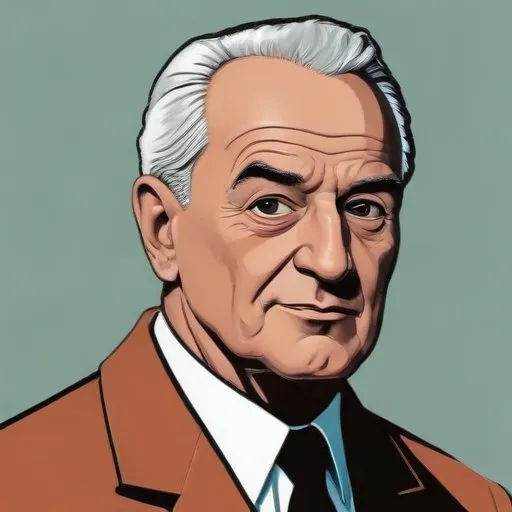
A Polish-American sculptor who created modernist works that blended folk art and abstraction, known for his simplified, stylized forms and innovative use of materials.
Elie Nadelman, a Polish-American sculptor, draughtsman, and collector of folk art, is renowned for his pioneering work in modern sculpture and his eclectic style that blended classical antiquities with avant-garde tendencies. His innovative approach to art, characterized by a fusion of traditional techniques and modernist sensibilities, has made him a prominent figure in the School of Paris.
Born into a Jewish family in Warsaw, Poland on February 20, 1882, Nadelman's early life was marked by a fascination with classical antiquities. He briefly studied in Warsaw before moving to Munich in 1902, where he became enamored with the Glyptothek, a museum dedicated to ancient Greek and Roman art. This exposure had a profound impact on his artistic vision, shaping his later work.
In 1904, Nadelman relocated to Paris, the epicenter of the art world, where he immersed himself in the avant-garde circle. He exhibited at the Société des Artistes Indépendants and the Salon d'Automne from 1905 to 1908, showcasing his innovative sculptures and drawings. His first solo exhibition in 1909 at the Galerie Druet, Paris, featured a series of plaster and bronze classical female heads and full-length standing nudes, demonstrating his mastery of classical techniques.
Nadelman's life took a significant turn with the outbreak of World War I, prompting his move to the United States in 1914. He became an American citizen in 1927 and married Viola Flannery, a wealthy heiress, in 1920. Together, they assembled an extensive collection of folk art, which eventually led to the establishment of the Museum of Folk Arts in Riverdale, New York, in 1925.
Nadelman's work defied categorization, blending classical, decorative, and urban folk art elements. He experimented with large, inexpensive editions of simple, classical figures, inspired by Tanagra sculptures. His later work, characterized by a focus on folk art, reflected his passion for collecting and preserving traditional craftsmanship. Despite struggling financially during the Great Depression, Nadelman continued to create, leaving behind a legacy that has influenced generations of artists.
Elie Nadelman's innovative approach to sculpture, his passion for folk art, and his eclectic style have had a lasting impact on modern art. His work has inspired generations of artists, from modernists like Constantin Brancusi to contemporary sculptors like Alberto Giacometti. His legacy continues to be felt in the art world, with his works remaining a testament to his boundless creativity and artistic vision.
"I want to make sculpture that is as simple as a kitchen utensil, as direct as a folk song." - Elie Nadelman
Nadelman's life and work spanned a period of great artistic and cultural upheaval, from the avant-garde movements of early 20th-century Paris to the rise of American modernism. His legacy serves as a bridge between these two eras, highlighting the importance of preserving traditional craftsmanship and embracing innovation. Today, his works can be found in prominent museums and private collections worldwide, a testament to his enduring influence on modern art.
Born in 1898
A pioneer of modern sculpture, creating abstract, biomorphic forms that evoke a sense of primal emotion, and illustrating books with whimsical, dreamlike drawings.
Born in 1903
A pioneering modernist sculptor, creating abstract, biomorphic forms that explore the relationship between nature and the human experience. Her works often feature smooth, curved surfaces and holes, symbolizing a connection to the natural world.
Born in 1901
A pioneer of modern art, creating elongated, abstract human figures that capture the essence of humanity, and exploring the relationship between sculpture and space.
Born in 1887
A pioneering artist who challenged conventional norms by submitting a urinal as art, sparking a revolution in conceptual art and questioning the very definition of art itself.
Born in 1890
A pioneer of avant-garde photography, this artist experimented with techniques like solarization and rayography, creating surreal, dreamlike images that blurred the line between art and photography.
Born in 1881
A pioneer of Cubism, this artist's bold, geometric works blended modernity with ancient forms, influencing generations of artists and designers.
