


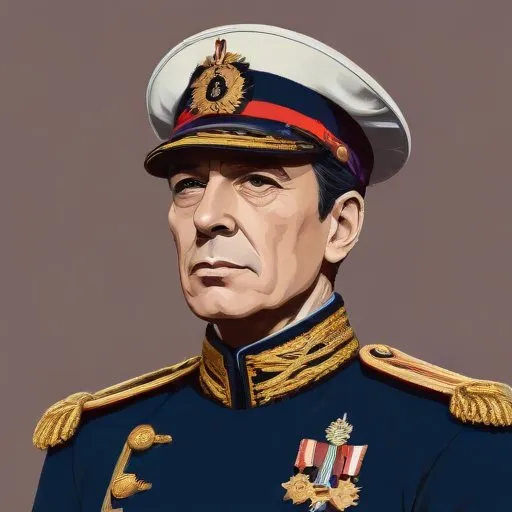
An Argentine naval officer who served as a commander of the Navy and a member of the military junta that ruled Argentina from 1976 to 1983, notorious for human rights abuses and forced disappearances.
Emilio Eduardo Massera, a renowned Argentine Naval military officer, is remembered for his pivotal role in the Argentine coup d'état of 1976 and his alleged involvement in the country's infamous Dirty War. As a leading figure in the military junta, Massera's regime was marked by human rights violations, with an estimated 30,000 people killed or disappeared during his tenure.
Born on October 19, 1925, in Paran, Entre Ríos, Argentina, Massera was the grandson of Swiss immigrants. He followed in his family's footsteps by pursuing a naval career, enrolling in Argentina's Naval Military School in 1942. He earned his commission as a midshipman in 1946 and gradually rose through the ranks, holding various positions within the Navy, including command of the sail training ship ARA Libertad and command of the Sea Fleet in 1973.
In 1976, Massera, along with Jorge Rafael Videla and Orlando Ramón Agosti, staged a coup d'état, overthrowing President Isabel Perón and establishing a military junta. During his regime, Massera was suspected of masterminding the Dirty War, a campaign of state-sponsored terrorism aimed at suppressing political opponents and dissidents. This period was marked by widespread human rights abuses, forced disappearances, and extrajudicial killings.
In 1981, it was discovered that Massera was a member of P2, a clandestine Masonic lodge involved in Italy's strategy of tension. P2 was accused of plotting to overthrow the Italian government and instigating acts of terrorism. Massera's connection to P2 fueled speculation about his involvement in international conspiracies and added to his notoriety.
Massera's regime and the Dirty War had a profound impact on Argentine society, leaving deep scars and a legacy of fear and mistrust. His actions and ideology have been widely condemned, and he remains a controversial figure in Argentine history. Today, his name serves as a reminder of the dangers of unchecked power and the importance of upholding human rights and democratic principles.
Emilio Eduardo Massera's life and legacy are a complex and multifaceted topic, sparking ongoing debates and discussions about the nature of authority, power, and human rights. As a prominent figure in Argentina's tumultuous past, Massera's story continues to captivate and disturb, serving as a testament to the enduring importance of accountability and justice.
Born in 1895
The authoritarian leader who ruled Argentina with his charismatic wife Eva, implementing populist economic policies and promoting nationalism, while suppressing opposition and civil liberties.
Born in 1919
A former actress who used her charisma and influence to advocate for women's suffrage and workers' rights, becoming a beloved and powerful figure in Argentine politics.
99 Years Old
The first democratically elected president of Argentina after a period of military rule, known for his efforts to promote human rights and democracy in the country.
96 Years Old
The 50th President of Argentina, a lawyer-turned-politician who implemented neoliberal economic policies and pardoned military officers involved in human rights abuses during the country's Dirty War. He's also known for his flamboyant style and corruption scandals.
89 Years Old
Led Argentina through a tumultuous period, implementing economic reforms and navigating corruption scandals, while also being a key figure in the country's transition to democracy. Known for his efforts to stabilize the economy and promote human rights.
76 Years Old
The 51st President of Argentina, who served from 2003 to 2007, is known for his efforts to rebuild the country's economy and restore its international reputation after a severe crisis. He's also recognized for his human rights advocacy and social welfare programs.
