


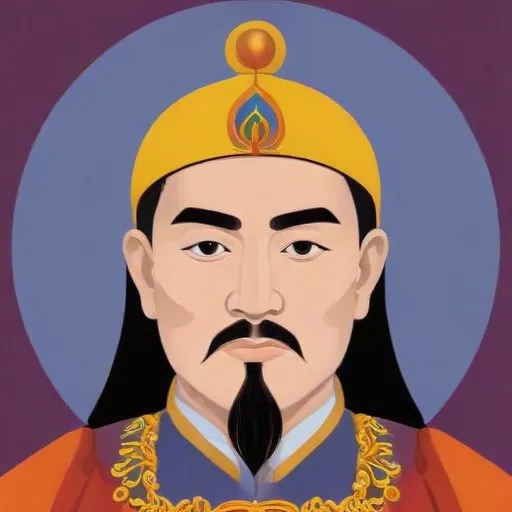
Founder of the Jin dynasty, known for reunifying northern China and establishing a strong, centralized government. He's also credited with creating a powerful military and administrative system.
Emperor Taizu of Jin, also known as Aguda, is renowned for being the founder and first emperor of the Jin dynasty of China, a powerful empire that ruled northern China from the 12th to the 13th century. He is credited with uniting the Jurchen tribes and successfully rebelling against the Liao dynasty, establishing the Jin dynasty in 1115.
Born on August 1, 1068, near the Ashi River in present-day Harbin, Heilongjiang Province, Aguda was an eighth-generation descendant of Hanpu, the great progenitor of the Wanyan clan. His father, Helibo, was the chieftain of the Wanyan clan, and his mother was a daughter of the chieftain of the Nalan tribe.
Aguda demonstrated exceptional bravery from a young age, participating in numerous campaigns against rival Jurchen tribes under the command of the Khitan-led Liao dynasty. In 1109, during a widespread famine, he assisted his father in absorbing famished warriors from other Jurchen tribes, strengthening his own tribe.
In 1113, Aguda succeeded his elder brother, Wuyashu, as the leader of his tribe. He then fought wars against other Jurchen tribes, eventually unifying all Jurchens under the Wanyan tribe's leadership. This unification laid the foundation for the Jin dynasty.
Aguda was dissatisfied with the exploitation of his tribesmen by corrupt Liao officials. In 1112, he began to secretly gather support among the Jurchen tribes, preparing for a rebellion against the Liao dynasty. In 1114, he declared war on the Liao dynasty, and by 1115, he had captured several key cities, including the Liao capital, Shangjing (modern-day Baicheng, Jilin Province).
In 1115, Aguda declared himself emperor, establishing the Jin dynasty. He adopted the title "Taizu," meaning "Grand Progenitor," and began to consolidate his power, creating a robust administrative system and military structure.
By the time of his death in 1123, the Jin dynasty had conquered most of the Liao dynasty's territories, emerging as a major power in northern China. Aguda's legacy extended far beyond his military conquests, as he also introduced policies to promote agriculture, reduce taxes, and encourage education.
In 1145, his descendant Emperor Xizong posthumously honored him with the temple name Taizu, solidifying his position as one of the most important emperors in Chinese history.
Emperor Taizu of Jin's rise to power and the founding of the Jin dynasty marked a significant turning point in Chinese history. His rebellion against the Liao dynasty and subsequent conquests ended the Liao dynasty's dominance and paved the way for the Jin dynasty to become a major power in northern China.
Aguda's legacy extends beyond his military conquests, as he introduced policies to promote agriculture, reduce taxes, and encourage education, leaving a lasting impact on Chinese society and politics.
Born in 1075
A ruler of the Jin dynasty in ancient China, known for his military conquests and reunification of northern China, establishing a strong and stable empire. He's also revered for his fair and benevolent governance.
