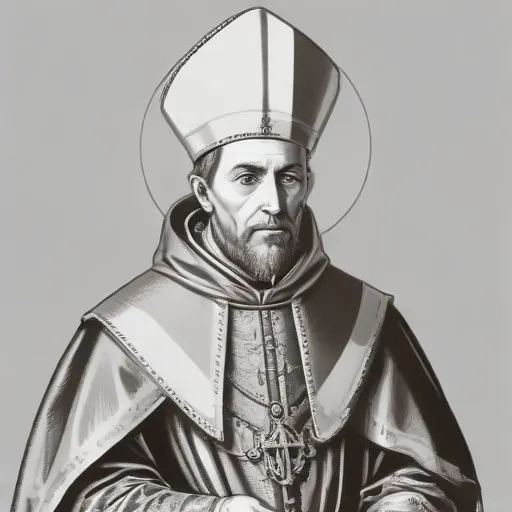
Ernst II of Saxony: The Visionary Archbishop
A Life of Spiritual Leadership and Political Acumen
Ernst II of Saxony, a member of the illustrious House of Wettin, is renowned for holding two esteemed episcopal titles: Archbishop of Magdeburg from 1476 until his death, and Administrator of the Diocese of Halberstadt from 1480 until his demise in 1513. During his remarkable tenure, he skillfully navigated the intricate web of politics and faith, leaving an indelible mark on the ecclesiastical and secular realms.
Early Life and Family Ties
Born on June 26 or 27, 1464, Ernst was the third child of
Ernest, Elector of Saxony, and his wife Elisabeth of Bavaria. As a younger brother of Elector
Frederick III the Wise of Saxony, Ernst was destined for a religious career, a calling that would shape his life's purpose.
Rise to Prominence: The Appointment as Archbishop of Magdeburg
Following the death of Archbishop John of Palatinate-Simmern in 1475, the Wettin family orchestrated a concerted effort to secure Ernst's postulation as Archbishop of Magdeburg. Despite being only 11 years old at the time, Ernst's family succeeded in obtaining the required two-thirds majority from the cathedral chapter in January 1476. However, the young Ernst did not meet the necessary requirements for the position, including the minimum age of 30, ordination as a priest, and a university education. To overcome these hurdles, the Wettins obtained a papal dispensation from
Pope Sixtus IV in 1478, which confirmed Ernst's election and solidified his position as Prince-Archbishop of the Archbishopric of Magdeburg.
Ernst's Relationship with Halle: A City in Turmoil
During Ernst's tenure, Halle was embroiled in social and political unrest between the urban aristocrats and the owners of the salt factory. Ernst's leadership and diplomatic prowess helped mitigate the conflicts, earning him the respect and admiration of the city's inhabitants.
Legacy and Impact
Ernst II of Saxony's remarkable life serves as a testament to his unwavering dedication to his faith and his people. His astute political acumen, coupled with his spiritual leadership, has left an enduring legacy that continues to inspire generations. As a visionary Archbishop, Ernst II of Saxony will forever be remembered as a champion of wisdom, compassion, and unity.
- Did you know? Ernst II of Saxony was just 11 years old when he was appointed as Archbishop of Magdeburg, making him one of the youngest archbishops in history.
- Ernst's episcopal titles include Archbishop of Magdeburg (1476-1513) and Administrator of the Diocese of Halberstadt (1480-1513).
Visual Timeline of Ernst II of Saxony's Life
| Year |
Event |
| 1464 |
Birth of Ernst II of Saxony |
| 1475 |
Death of Archbishop John of Palatinate-Simmern |
| 1476 |
Ernst appointed as Archbishop of Magdeburg |
| 1478 |
Papal dispensation granted by Pope Sixtus IV |
| 1480 |
Ernst appointed as Administrator of the Diocese of Halberstadt |
| 1513 |
Death of Ernst II of Saxony |
A Lasting Legacy
Ernst II of Saxony's remarkable life serves as a testament to the power of faith, leadership, and vision. As a beacon of inspiration, his legacy continues to illuminate the path for generations to come, reminding us of the importance of compassion, wisdom, and unity.
FAQ
Who was Ernst II of Saxony?
Ernst II of Saxony was the Archbishop of Magdeburg from 1476 to 1513. He was a member of the House of Wettin and played an important role in the politics of the Holy Roman Empire.
What were Ernst II of Saxonys accomplishments as Archbishop of Magdeburg?
Ernst II of Saxony was a skilled diplomat and administrator who strengthened the Archbishopric of Magdeburg. He also played a key role in the Imperial Diet and was a strong supporter of the Habsburgs.
What was Ernst II of Saxonys relationship with the Habsburgs?
Ernst II of Saxony was a close ally of the Habsburgs and supported their claims to the throne of the Holy Roman Empire. He even served as a regent for the young King Charles V of Spain.
What was Ernst II of Saxonys role in the Imperial Diet?
Ernst II of Saxony played a leading role in the Imperial Diet, where he represented the interests of the Archbishopric of Magdeburg and the House of Wettin. He was a strong advocate for the rights of the nobility and the Church.
What is Ernst II of Saxonys legacy?
Ernst II of Saxonys legacy is that of a skilled diplomat and administrator who played a key role in the politics of the Holy Roman Empire. He is also remembered for his support of the Habsburgs and his strengthening of the Archbishopric of Magdeburg.