


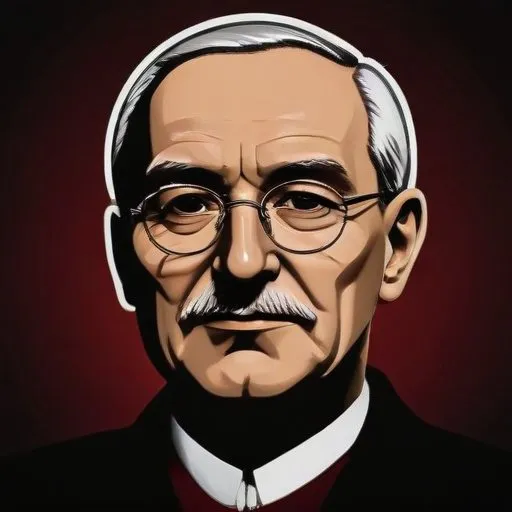
Developed a theory of ideal numbers, which laid the foundation for modern algebraic number theory, and made significant contributions to the field of mathematics.
Ernst Kummer is renowned for his groundbreaking contributions to mathematics, particularly in the realm of hypergeometric series. His pioneering work in this field led to the development of contiguity relations, which have far-reaching implications in number theory and algebraic geometry.
Born on January 29, 1810, in Sorau, Brandenburg, Prussia, Kummer was destined for greatness. He received his PhD from the University of Halle in 1831 for his prize-winning essay, "De cosinuum et sinuum potestatibus secundum cosinus et sinus arcuum multiplicium evolvendis," which was published a year later.
Kummer's passion for mathematics led him to teach German army officers in ballistics, and later, for 10 years, at a gymnasium, the German equivalent of high school. It was during this period that he inspired the mathematical career of Leopold Kronecker, a prominent mathematician in his own right.
Kummer's work on hypergeometric series led to the codification of contiguity relations, which have significant implications in number theory and algebraic geometry. He also made notable contributions to the study of Kummer surfaces, early orbifolds with 16 singular points, whose geometry was intensively studied in the 19th century.
One of Kummer's most remarkable achievements was his proof of Fermat's Last Theorem for a considerable class of prime exponents. His methods, although differing from ideal theory as understood later, laid the foundation for the development of ideal class groups.
In 1840, Kummer married Ottilie Mendelssohn, daughter of Nathan Mendelssohn and Henriette Itzig, and cousin of Felix Mendelssohn. After Ottilie's death in 1848, Kummer married Bertha Cauer, a maternal cousin of Ottilie. He had 13 children, with one of his daughters, Marie, marrying the mathematician Hermann Schwarz.
Kummer retired from teaching and mathematics in 1890 and passed away on May 14, 1893, in Berlin. His legacy extends far beyond his mathematical contributions, as his work continues to inspire generations of mathematicians and shape the course of mathematical inquiry.
Ernst Kummer's remarkable life and achievements serve as a testament to his boundless passion for mathematics and his enduring legacy in the field.
Born in 1777
A pioneer in mathematics and physics, he made major contributions to number theory, algebra, and electromagnetism, shaping our understanding of the natural world.
Born in 1805
A German mathematician and academic who made significant contributions to number theory, particularly in the development of the Dirichlet's theorem, and was one of the first mathematicians to give lectures on the subject. He also worked on the theory of Fourier series and its applications.
Born in 1826
A pioneering mathematician who developed the theory of higher dimensions and laid the foundations for modern physics, particularly in the understanding of space and time.
Born in 1831
Developed a rigorous definition of real numbers and introduced the concept of Dedekind cuts, revolutionizing mathematics and laying the foundation for modern analysis. His work also explored the nature of infinity and the foundations of mathematics.
Born in 1823
A pioneer in number theory, this mathematician developed the concept of ideals and contributed significantly to the development of modern algebra. Their work laid the foundation for many mathematical advancements.
