


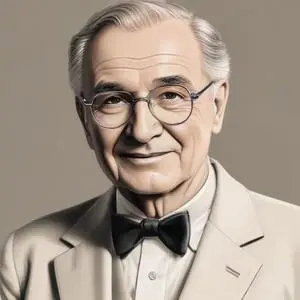
Developed the first electron microscope, revolutionizing the field of microscopy and enabling scientists to study materials at the atomic level.
Ernst Ruska, a renowned German physicist, is celebrated for his groundbreaking work in electron optics, particularly the design of the first electron microscope. This Nobel Prize-winning innovation revolutionized the scientific community, allowing for unprecedented insights into the microscopic world.
Born on December 25, 1906, in Heidelberg, Germany, Ruska's curiosity and passion for physics led him to pursue higher education at the Technical University of Munich and later at the Technische Hochschule Berlin (now Technische Universität Berlin).
During his time at Technische Hochschule Berlin, Ruska proposed the concept of using electrons, with wavelengths 1000 times shorter than light, to create a more detailed picture of an object than a traditional microscope. This idea sparked a lifelong dedication to the development of electron optics.
In 1931, Ruska successfully demonstrated that a magnetic coil could function as an electron lens. He then used this discovery to build the first electron microscope in 1933, opening doors to new possibilities in scientific research.
After completing his Ph.D. in 1933, Ruska continued to work in the field of electron optics, first at Fernseh AG in Berlin-Zehlendorf and later at Siemens-Reiniger-Werke AG. During his time at Siemens, he played a crucial role in developing the first commercially produced electron microscope in 1939.
Ruska's groundbreaking contributions to electron optics earned him numerous accolades, including the Lasker Award in 1960. The pinnacle of his recognition came in 1986, when he was awarded half of the Nobel Prize in Physics for his outstanding achievements in electron optics, alongside Gerd Binnig and Heinrich Rohrer.
Ruska's invention of the electron microscope has had a profound impact on modern science, enabling researchers to explore the microscopic world with unprecedented precision. His work has far-reaching implications for various fields, including biology, medicine, and materials science.
Throughout his career, Ruska encouraged collaboration and knowledge sharing, inspiring future generations of scientists. His legacy continues to inspire innovation and discovery, solidifying his place as a pioneer in the field of electron optics.
In addition to his work in industry, Ruska held academic positions at the Fritz Haber Institute and Technische Universität Berlin, where he served as a professor from 1957 to 1974. He also directed the Institute for Electron Microscopy of the Fritz Haber Institute until 1974.
Ruska's commitment to education and scientific advancement has left an indelible mark on the scientific community, ensuring his work continues to inspire and educate future generations of scientists and researchers.
Ruska's remarkable life, marked by groundbreaking achievements and a passion for scientific discovery, continues to inspire and educate us today.
Born in 1879
A brilliant physicist who developed the theory of relativity and is considered one of the most influential scientists of the 20th century, known for his groundbreaking work in physics and mathematics.
Born in 1901
A pioneer in quantum mechanics, he formulated the uncertainty principle, which revolutionized our understanding of the atomic world. His groundbreaking work reshaped modern physics.
Born in 1885
A pioneer in quantum mechanics, he introduced the concept of wave-particle duality, revolutionizing our understanding of atomic structure. His philosophical approach to science also explored the nature of reality and human understanding.
Born in 1867
A pioneering scientist who pioneered radioactivity research, discovering elements polonium and radium, and paving the way for breakthroughs in medicine and energy.
Born in 1858
A pioneer in quantum theory, he introduced the concept of the Planck constant, revolutionizing our understanding of energy and matter.
Born in 1879
A pioneering nuclear chemist who discovered nuclear fission, a process that releases massive energy from atomic nuclei, and was awarded the Nobel Prize in Chemistry in 1944.
Born in 1878
Pioneering physicist who made groundbreaking contributions to nuclear physics, including the discovery of nuclear fission, and was the first woman to become a full professor of physics in Germany.
