


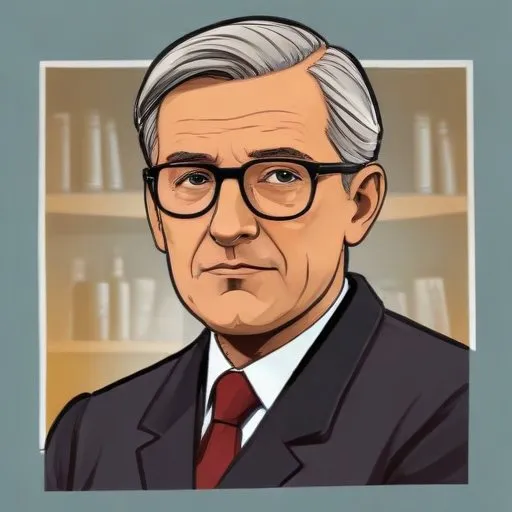
A prominent German lawyer and jurist who served as the President of the Reichsgericht, the highest court in Germany, during the Weimar Republic, known for his efforts to maintain judicial independence. He played a crucial role in shaping the country's legal system during a tumultuous period.
Erwin Bumke was a German lawyer and judge, best known for being the last president of the Reichsgericht, the supreme civil and criminal court of the German Reich, serving from 1929 to 1945. As such, he should have become the Acting President of Germany upon the death of Paul von Hindenburg in August 1934, making him the head of state of Nazi Germany.
Bumke was born on July 7, 1874, in Stolp, Pomerania (now Ślupsk, Poland). He came from a middle-class family, with his father being a doctor and his mother being a factory owner's daughter. His brother, Oswald Bumke, went on to become a noted psychiatrist.
Bumke studied law in Freiburg, Leipzig, Munich, Berlin, and Greifswald, and began his career as a judge in Essen. In 1907, he assumed an office in the Reichsjustizamt, the precursor to the later Reich Ministry of Justice.
In 1930, Bumke became the president of the International Criminal Law and Prison Commission. Upon the resignation of Walter Simons in 1929, Bumke was appointed as the head of the Reichsgericht by President Paul von Hindenburg.
As the head of the Reichsgericht, Bumke was responsible for interpreting the laws of the Weimar Republic. He played a crucial role in shaping the legal framework of Nazi Germany, although his role has often been overshadowed by the more prominent figures of the Nazi regime.
The death of Paul von Hindenburg in August 1934 led to a constitutional crisis in Germany. According to the Weimar Constitution, Bumke, as the head of the Reichsgericht, should have become the Acting President of Germany. However, the Hitler cabinet passed the Law Concerning the Head of State of the German Reich, which combined the presidency with the chancellorship, making Adolf Hitler the undisputed ruler of Germany.
This move was a clear violation of the constitution, and Bumke's role in this crisis remains a topic of controversy among historians. Some argue that he should have taken a more proactive stance against Hitler's power grab, while others see him as a mere pawn in the larger game of Nazi politics.
Bumke married Eva von Merkatz in 1907, and the couple had two sons, both of whom were killed in World War II. Bumke himself served as an officer in World War I, achieving the rank of Hauptmann (Captain).
Despite his significant role in German history, Bumke's legacy remains somewhat obscure. He died on April 20, 1945, just before the end of World War II.
Erwin Bumke's life and legacy serve as a reminder of the complexities of German history during the early 20th century. His story highlights the struggles of those who lived through this tumultuous period, and the difficult choices they had to make in the face of rising authoritarianism.
Born in 1822
A Latvian-German chemist and academic who pioneered the field of biochemistry, discovering various compounds and contributing significantly to the understanding of proteins and amino acids.
Born in 1881
A Czech-American jurist and philosopher who developed the "pure theory of law," which separates law from morality and politics, and is also known for his work on international law and the concept of sovereignty.
