


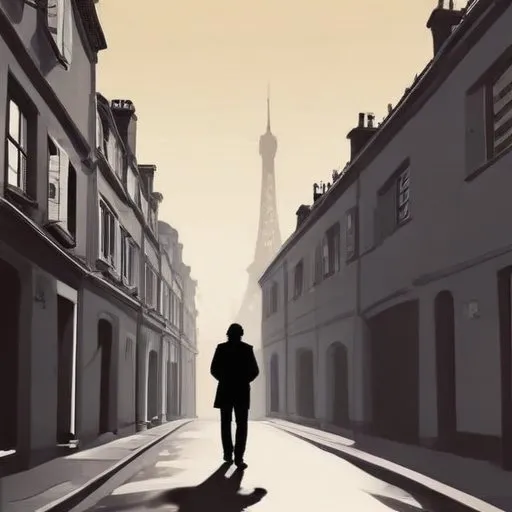
Documenting Paris' streets, architecture, and everyday life through photographs, capturing the city's essence and beauty. 40
Eugne Atget is renowned for his meticulous documentation of Paris' architecture, streets, and urban landscapes, capturing the city's essence before modernization transformed it. His pioneering work in documentary photography has inspired generations of artists, architects, and photographers, cementing his legacy as one of the most important figures in the history of photography.
Atget was born on February 12, 1857, in Libourne, France, to a carriage builder father and a mother who died shortly after his birth. He was raised by his maternal grandparents in Bordeaux and later joined the merchant navy. In 1878, he moved to Paris, where he pursued an acting career, eventually becoming a traveling actor performing in the provinces.
Due to an infection of his vocal cords, Atget was forced to abandon his acting career in 1887. He then turned to painting, but with little success. In 1888, at the age of 30, he took his first photographs, capturing scenes of Amiens and Beauvais. This marked the beginning of his photography career, which would span over four decades.
In 1890, Atget returned to Paris and dedicated himself to photography, supplying documents for artists, painters, architects, and stage designers. His photographs served as reference materials, allowing artists to study and recreate Paris' architecture, streets, and urban landscapes in their work.
Atget's mission was to document every aspect of Paris, from its grand monuments to its humblest streets and alleyways. He photographed the city's old buildings, bridges, and fountains, as well as its markets, cafes, and shopfronts. His work provided a comprehensive record of Paris' urban landscape, preserving its history for future generations.
Atget's photographs were first published by Berenice Abbott after his death, introducing his work to a wider audience. His influence can be seen in the Surrealist movement, which drew inspiration from his documentation of Paris' urban landscape.
Today, Atget is recognized as a pioneer of documentary photography, and his work continues to inspire artists, architects, and photographers around the world. His photographs are held in high esteem, with institutions such as the Muse Carnavalet and the Bibliothque historique de la ville de Paris possessing extensive collections of his work.
Atget met actress Valentine Delafosse Compagnon, who became his companion until her death. He remained dedicated to his work, producing over 8,000 photographs during his lifetime.
Some notable milestones in Atget's life include:
"Nothing is more pleasant than taking a trip to the countryside, and nothing is more tedious than documenting it." - Eugne Atget
Atget's humility and dedication to his craft are reflected in this quote, which highlights the meticulous nature of his work.
Atget's work provides a unique window into Paris' urban landscape during the late 19th and early 20th centuries. His photographs serve as a historical record, preserving the city's architectural heritage and documenting the impact of modernization.
Atget's legacy extends beyond the realm of photography, influencing artists, architects, and urban planners. His work continues to inspire new generations, ensuring his place as one of the most important figures in the history of photography.
Born in 1908
A pioneer of street photography, capturing life's fleeting moments in elegant, geometric compositions that defined the genre. Known for coining the term "the decisive moment."
Born in 1890
A pioneer of avant-garde photography, this artist experimented with techniques like solarization and rayography, creating surreal, dreamlike images that blurred the line between art and photography.
Born in 1912
A French photographer and journalist, capturing intimate, humorous, and poignant moments of everyday life in post-war France, particularly in Paris, through his iconic black-and-white images.
