


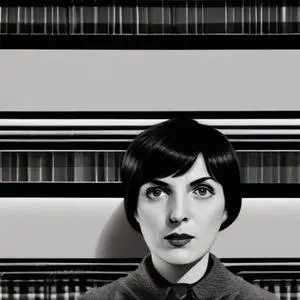
Pioneering photographer capturing urban landscapes and portraits, particularly in New York City, with a unique perspective and style that influenced generations of photographers.
Berenice Abbott, an American photographer, is renowned for her captivating portraits of cultural icons, striking images of New York City's architecture and urban design, and innovative scientific photographs that interpreted the world of physics and philosophy. Her distinctive style, which blended art and science, has left an indelible mark on the world of photography.
Born on July 17, 1898, in Springfield, Ohio, Abbott grew up in a family of modest means. Her divorced mother, Lillian Alice Bunn, played a significant role in shaping her early life. Abbott's initial foray into the world of art began at The Ohio State University, where she studied sculpture and painting for two semesters. However, her academic journey was cut short when her professor was dismissed due to his German heritage.
Abbott's move to New York City marked the beginning of her transition from sculpture to photography. She became an apprentice to the celebrated artist Man Ray, who sought someone with no prior knowledge of photography. This chance encounter would prove serendipitous, as Abbott's lack of technical expertise allowed her to approach photography with a fresh perspective.
Abbott's time in Paris, where she studied sculpture with Emile Bourdelle, was instrumental in shaping her artistic identity. It was during this period that she adopted the French spelling of her first name, Berenice, at the suggestion of Djuna Barnes. Her involvement with the experimental literary journal transition further solidified her connection to the artistic circle.
In 1921, Abbott's photography career took off when her work was showcased in the prestigious Parisian gallery Le Sacre du Printemps. Her move back to Paris in 1927 marked the beginning of a new chapter, as she established her own studio and continued to hone her craft.
Abbott's photographic repertoire is characterized by its diversity and depth. Her portraits of cultural icons, such as James Joyce, Eugène Atget, and Marie Curie, are celebrated for their intimacy and nuance. Her documentation of New York City's urban landscape, captured through her lens in the 1930s, provides a fascinating glimpse into the city's architectural evolution.
Abbott's foray into scientific photography, which spanned several decades, resulted in a fascinating body of work that interprets the principles of physics and philosophy. Her images, which often featured everyday objects, challenged the viewer's perceptions and encouraged a deeper understanding of the world around them.
Abbott's contributions to the world of photography have been widely recognized. In 1982, she was awarded the Honorary Fellowship of the American Institute of Architects, a testament to her groundbreaking work in architectural photography. Her legacy continues to inspire generations of photographers, ensuring her place as one of the most visionary artists of the 20th century.
Abbott's personal life was marked by her unwavering dedication to her craft. Her relationships with prominent figures, including Djuna Barnes and Thelma Wood, were integral to her artistic development. Abbott's philosophy, which emphasized the importance of artistic expression, is reflected in her statement, "I took to photography like a duck to water. I never wanted to do anything else."
In conclusion, Berenice Abbott's extraordinary life and body of work serve as a testament to her boundless creativity and innovative spirit. Her legacy continues to captivate audiences, inspiring future generations to explore the intersection of art and science.
Abbott's impact on modern society extends beyond the realm of photography. Her work has influenced architects, urban planners, and scientists, encouraging them to adopt a more holistic approach to their respective fields. Her legacy serves as a testament to the power of artistic expression, inspiring individuals to challenge conventional norms and push the boundaries of innovation.
Born in 1895
Documented the lives of those affected by the Great Depression and the Dust Bowl through powerful, poignant photographs that humanized the struggles of the era. Captured iconic images that shaped the national conversation around poverty and social justice.
Born in 1904
Pioneering photographer and journalist who captured iconic images of the Great Depression and World War II, and was the first woman to fly on a combat mission.
Born in 1902
Pioneering landscape photographer and conservationist capturing iconic black-and-white images of the American West, advocating for environmental protection through art.
Born in 1879
A pioneering photographer and painter who blurred the lines between art and commerce, capturing iconic images for Vogue and Harper's Bazaar while pushing the boundaries of modern art.
Born in 1864
A pioneering photographer and curator who promoted modern art in the early 20th century, showcasing works by avant-garde artists like Georgia O'Keeffe and Henri Matisse.
Born in 1890
A pioneer of avant-garde photography, this artist experimented with techniques like solarization and rayography, creating surreal, dreamlike images that blurred the line between art and photography.
Born in 1923
A pioneering photographer who captured intimate, often unsettling portraits of marginalized individuals, revealing the beauty in the unconventional and challenging societal norms.
98 Years Old
A pioneer of street photography, capturing candid, unposed moments of everyday life in post-war America, revealing the beauty in the mundane.
