


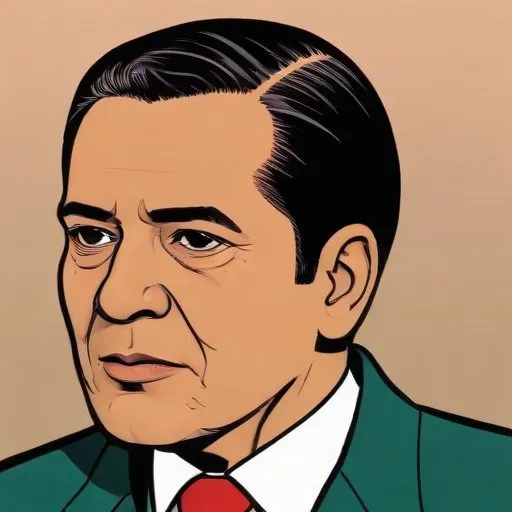
Led Mexico's government during a tumultuous period, implementing reforms and fighting against foreign intervention. He's remembered for his strong leadership and nationalist stance.
Eulalio Gutirrez Ortiz, a general in the Mexican Revolution, is often remembered for his brief but tumultuous stint as the provisional president of Mexico. From November 1914 to January 1915, Gutirrez led the country through a period of intense violence and factionalism, leaving an indelible mark on Mexico's tumultuous history.
Born on February 2, 1881, at the Hacienda de Santo Domingo in Ramos Arizpe, Coahuila, Gutirrez grew up to become a shepherd and miner in Concepción del Oro, Zacatecas. His early life was marked by humble beginnings, but he soon found himself drawn to politics, joining Ricardo Flores Magón's Mexican Liberal Party in 1909.
After a brief stint with the Antireelectionist Party of Francisco I. Madero, Gutirrez's natural leadership skills and combat prowess earned him recognition among the revolutionaries. He participated in the Mexican Revolution, eventually returning to his native state, where he was appointed mayor of Concepción del Oro.
In 1914, the Convention of Aguascalientes was convened by revolutionaries who had successfully ousted the regime of Victoriano Huerta. In a surprise move, Gutirrez was chosen as the provisional president of Mexico, superseding First Chief Venustiano Carranza. This decision sparked a new wave of violence as revolutionary factions turned against each other.
Gutirrez's presidency was marked by instability, as he struggled to control the two main generals of the Army of the Convention, Pancho Villa and Emiliano Zapata. Despite his efforts, Gutirrez's government remained weak, and he was eventually forced to resign and make peace with Carranza.
Gutirrez went into exile in the United States, but later returned to Mexico. He lived a quiet life, outliving many other major figures of the Mexican Revolution. Gutirrez passed away on August 12, 1939, leaving behind a complex legacy that would continue to shape Mexico's history.
Eulalio Gutirrez's brief tenure as president may have been marked by turmoil, but it also represents a critical moment in Mexico's struggle for stability and democracy. His story serves as a testament to the complexities of the Mexican Revolution, highlighting the factionalism and power struggles that shaped the country's destiny.
Today, Gutirrez remains a fascinating figure, often overshadowed by more prominent revolutionaries like Pancho Villa and Emiliano Zapata. Nevertheless, his contribution to Mexico's rich history cannot be overstated, and his legacy continues to inspire new generations of historians and scholars.
"La revolución es la gran fuerza que hará cambiar a México, pero debemos unirnos para lograrlo."
—"The revolution is the great force that will change Mexico, but we must unite to achieve it."
Born in 1806
A champion of democracy and indigenous rights, he modernized Mexico, abolished slavery, and limited church power. He's revered as a national hero for his progressive reforms.
Born in 1830
A Mexican general and politician who ruled Mexico with an iron fist from 1876 to 1911, modernizing the country while suppressing dissent and opposition. He's infamous for his authoritarian regime and eventual exile.
Born in 1850
A ruthless and cunning leader who seized power in Mexico through a coup, known for his brutal suppression of opposition and role in sparking the Mexican Revolution.
Born in 1880
Mexican general and politician who served as the 39th President of Mexico, known for his role in the Mexican Revolution and his efforts to modernize the country. He's also famous for losing his right arm in battle and continuing to serve as president.
Born in 1877
Mexican revolutionary leader who served as president from 1924 to 1928, known for implementing secular and anti-clerical policies, including restricting the Catholic Church's power. He also founded the National Revolutionary Party, which later became the dominant party in Mexico.
Born in 1895
A Mexican revolutionary general who served as president, implementing significant land reforms and nationalizing the oil industry, and father of a prominent politician.
