


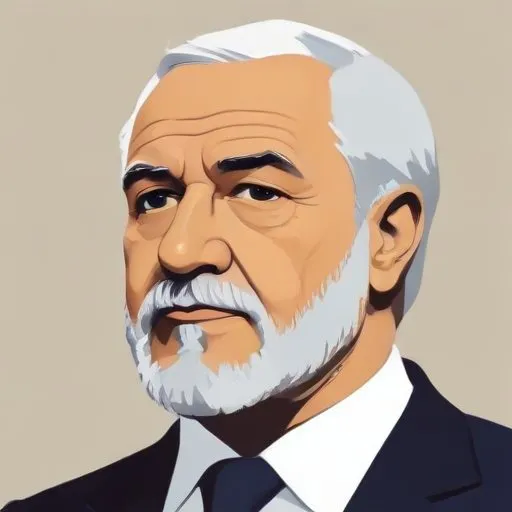
Greek Minister of Defence who played a crucial role in shaping Greece's military and foreign policy during the Cold War era, particularly in the 1960s and 1970s.
Evangelos Averoff is a name synonymous with Greek politics, particularly during the tumultuous times of World War II and the subsequent military junta. As a prominent politician, leader of the New Democracy party, and author, Averoff left an indelible mark on Greece's history, fighting for democracy and human rights amidst the dark clouds of oppression.
Born on April 17, 1910, in Trikala, Greece, Averoff was an Aromanian, a Greek minority group. His early involvement in public matters set the tone for his future endeavors. In 1940, he was appointed Prefect of Kerkyra (Corfu), a position that would test his mettle during the Axis occupation of Greece.
Averoff's refusal to collaborate with the Italian occupation forces in the region of Pindus led to his imprisonment in Italy. This brave act of defiance was a precursor to his subsequent escape in 1941, which paved the way for the formation of the Freedom or Death resistance group. This group's primary objective was to liberate Greek and Allied war hostages, showcasing Averoff's unwavering commitment to the fight for freedom.
In 1946, Averoff was elected to the Greek Parliament as a representative of Ioannina, marking the beginning of his storied political career. He went on to serve as Deputy Minister and Minister of Supply, Economy, and Agriculture, before becoming Foreign Minister from 1956 to 1963. His leadership and diplomatic prowess earned him recognition and respect across the political spectrum.
During the Greek military junta of 1967-1974, Averoff played a pivotal role in the Velos mutiny, a bold act of resistance against the government. This courageous stance led to his arrest as an instigator, but it also cemented his status as a champion of democracy and human rights.
Following the restoration of democracy in 1974, Averoff became a key figure in the New Democracy party under Konstantinos Karamanlis. He served as Minister of National Defense in subsequent governments, solidifying his reputation as a seasoned statesman. In 1981, he was elected President of the New Democracy party, a position he held until 1984, when he resigned due to health reasons.
Averoff's unwavering commitment to democracy, human rights, and freedom was the cornerstone of his political philosophy. He believed in the power of resistance and the importance of standing up against oppression, even in the face of overwhelming adversity.
Evangelos Averoff's life and career serve as a testament to the human spirit's capacity for courage, resilience, and dedication. His contributions to Greek politics and his fight for democracy have inspired generations, earning him a place in the annals of Greek history as a true hero and statesman.
As we reflect on Averoff's remarkable journey, we are reminded of the importance of standing up for what is right, even when the stakes are high. His legacy continues to inspire, motivating us to strive for a world where democracy, human rights, and freedom are cherished and protected.
Born in 1907
A Greek lawyer and politician who served as President of Greece, known for leading the country's transition from military dictatorship to democracy. He's credited with modernizing Greece and joining the European Union.
Born in 1888
A Greek lawyer, economist, and politician who served as the Prime Minister of Greece from 2009 to 2011, known for his efforts to address the country's debt crisis.
Born in 1864
A Greek statesman who played a crucial role in shaping modern Greece, leading the country through significant reforms and transformations. He's known for his visionary leadership and diplomatic prowess.
Born in 1919
Greek economist and politician who served as Prime Minister of Greece, known for his socialist policies and efforts to reduce Greece's reliance on foreign capital. He also played a key role in Greece's accession to the European Union.
Born in 1918
Greek lawyer and politician who served as the 178th Prime Minister of Greece, known for his efforts to modernize and liberalize the Greek economy. He played a key role in Greece's accession to the European Union.
Born in 1918
A Greek lieutenant-turned-politician who served as the 173rd Prime Minister of Greece, known for his brief but tumultuous tenure during a period of political and economic crisis.
Born in 1871
A Greek general and politician who served as the 130th Prime Minister of Greece, known for his authoritarian regime and opposition to the Axis powers during World War II. He implemented a series of reforms and modernization projects, but also suppressed political opposition and civil liberties.
Born in 1898
Greek Prime Minister from 1996 to 2004, known for his efforts to reform the Greek economy and prepare the country for the Eurozone. He also played a key role in resolving the Macedonia naming dispute.
