


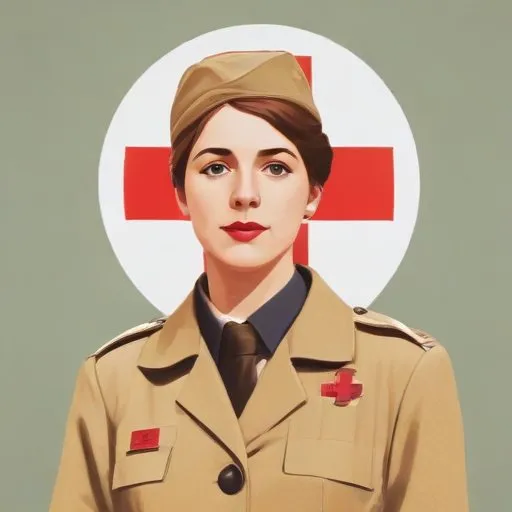
Leading member of the British Red Cross, recognized for pioneering humanitarian work and being the first female recipient of the CMG honor. Her groundbreaking efforts paved the way for women in leadership roles.
Evelyn Bark is renowned for her tireless efforts in providing humanitarian aid, particularly during World War II, where she played a crucial role in alleviating the suffering of concentration camp survivors. As a leading member of the British Red Cross, Bark's dedication and perseverance paved the way for numerous humanitarian initiatives, earning her numerous accolades and recognition.
Born on December 26, 1900, Evelyn Bark's life was marked by a strong sense of compassion and a desire to serve others. During World War II, she joined a Voluntary Aid Detachment, which eventually led her to become one of the first individuals to enter the notorious Bergen-Belsen concentration camp in 1944.
Within the camp, Bark worked tirelessly to reduce the mortality rate and establish a tracing service for survivors, which later evolved into the International Committee of the Red Cross's International Tracing Service. Her selfless efforts not only helped save countless lives but also paved the way for the creation of a vital lifeline for those seeking to reunite with their loved ones.
Bark's remarkable work in the concentration camps was merely the beginning of her illustrious career in humanitarianism. Following the war, she continued to work with the British Red Cross, eventually becoming the Director of International Affairs. In this capacity, she played a pivotal role in establishing Red Cross and Red Crescent societies across the globe, responding to successive crises and providing aid to those in need.
One of her most notable achievements during this period was coordinating relief efforts for Hungarian refugees in Austria in 1956, demonstrating her unwavering commitment to providing humanitarian aid in the face of crisis.
Evelyn Bark's tireless efforts were recognized and celebrated throughout her lifetime. In 1952, she was awarded an OBE (Order of the British Empire) for her services to humanity. In 1964, she was honored with an episode of the popular television show "This Is Your Life," a testament to her remarkable contributions to humanitarianism.
In 1965, when the Order of St. Michael and St. George was opened to women, Bark became the first female CMG (Companion of the Order of St. Michael and St. George) in the 1967 New Year Honours, a recognition of her exceptional dedication and service to humanity.
Evelyn Bark's remarkable life was marked by a sense of humility and dedication to her work. Despite her many achievements, she remained committed to her humanitarian work, inspiring countless individuals to follow in her footsteps.
On June 7, 1993, Evelyn Bark passed away, leaving behind a legacy of compassion, selflessness, and humanitarianism that continues to inspire generations today.
Evelyn Bark's remarkable life serves as a testament to the power of compassion, dedication, and humanitarianism. Her selfless efforts continue to inspire generations, and her legacy remains a shining example of the impact one individual can have on the world.
Born in 1820
Pioneering nurse and statistician who revolutionized healthcare by introducing sanitation practices and data-driven decision making, becoming the founder of modern nursing.
Born in 1865
A British nurse who helped soldiers from both sides during WWI, and was executed by the Germans for treason, becoming a symbol of courage and compassion.
Born in 1821
Founded the American Red Cross, providing humanitarian aid and disaster relief, and pioneering nursing education. Known for her courageous and selfless efforts during the Civil War and beyond.
Born in 1828
Co-founder of the Red Cross, a humanitarian organization providing aid in war zones and natural disasters, and a Nobel Peace Prize winner for his efforts. He pioneered the concept of international humanitarian law.
Born in 1862
A trailblazing explorer and writer who ventured into uncharted African territories, documenting her experiences and shedding light on the continent's cultures and customs.
Born in 1868
Pioneering archaeologist and spy who mapped and excavated ancient Mesopotamian sites, shaping Middle Eastern politics and cultural understanding.
Born in 1858
A leading figure in the British suffragette movement, fighting for women's right to vote through militant tactics and public demonstrations. Her activism led to significant social and political change.
