


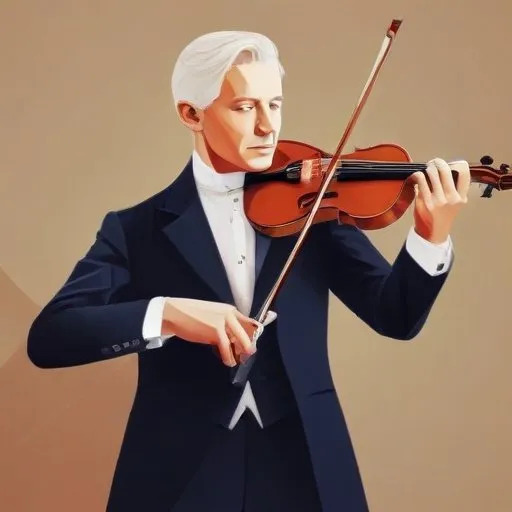
Founded the St. Olaf Choir and developed the a cappella choral tradition in the US, known for his innovative arrangements and performances of Nordic folk songs.
F. Melius Christiansen, a Norwegian-born violinist and choral conductor, is renowned for his remarkable a cappella choral arrangements and for founding The St. Olaf Choir in 1912. His legacy in the Lutheran choral tradition continues to inspire generations of music enthusiasts and choristers alike.
Born on April 1, 1871, in Eidsvold, Norway, Christiansen was introduced to music at a tender age. By three, he was playing the clarinet, and by six, he was marching in his father's band. He went on to master the violin, piano, and pipe organ, becoming proficient enough to take his teacher's place as the organist in Sunday services at a young age.
To further his musical education, Christiansen emigrated to the United States in 1889, initially settling in Oakland, California, and later moving to Washburn, Wisconsin, and Marinette, Wisconsin. It was in Marinette that he was inspired by a performance by a male quartet from Augsburg College, which led to his enrollment in 1892. He completed his freshman courses at Augsburg and later attended the Northwestern Conservatory of Music, graduating with honors in music theory and counterpoint.
In 1897, Christiansen moved to Leipzig, Germany, to study for two years at the Royal Conservatory of Music. During this period, he was deeply influenced by the St. Thomas Choir, directed by Gustav Schreck, who taught him counterpoint and conducting. This European sojourn played a significant role in shaping Christiansen's musical style and approach to choral direction.
In 1912, Christiansen founded The St. Olaf Choir, an ensemble that would become synonymous with excellence in choral music. Under his leadership, the choir gained renown for its a cappella performances, showcasing Christiansen's innovative arrangements and direction.
F. Melius Christiansen's contributions to choral music are immeasurable. His a cappella arrangements, characterized by intricate harmonies and lush textures, have become staples of the choral repertoire. The St. Olaf Choir, now in its 110th year, continues to perform and record Christiansen's arrangements, ensuring his legacy endures.
"Music is the only language that can express the deepest and highest feelings of humanity."
F. Melius Christiansen's life and work serve as a testament to the transformative power of music, inspiring generations to come.
Born in 1892
A renowned pianist and composer, he is best known for his iconic scores for films, television, and radio, including the famous "Grand Canyon Suite".
Born in 1810
A virtuosic violinist and composer who founded the Norwegian Theatre and was known for his romantic and expressive style, blending folk melodies with classical music.
Born in 1843
A renowned pianist and composer, famous for his iconic and romanticized musical interpretations of Norwegian folk culture, particularly his famous piano concerto.
Born in 1815
A Norwegian journalist and composer who wrote music inspired by Norwegian folk songs and was a key figure in the country's musical nationalism movement. He's known for his romantic and lyrical compositions.
Born in 1856
A renowned Norwegian pianist and composer, he was a prominent figure in the Romantic era, known for his lyrical and expressive piano music, particularly his famous "Rustle of Spring" piece.
