


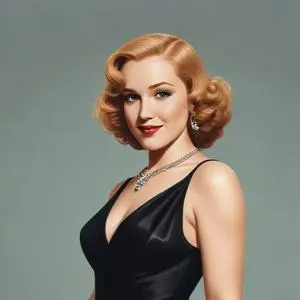
A Canadian-American actress who starred in numerous films, including the iconic 1933 movie "King Kong," where she played the role of Ann Darrow, the damsel in distress.
Fay Wray, the iconic actress who catapulted to fame as Ann Darrow in the 1933 classic King Kong, is often regarded as the first "Scream Queen" of Hollywood. With a career spanning nearly six decades, Wray's name is synonymous with horror films, earning her a permanent place in the annals of cinematic history.
Born on September 15, 1907, on a ranch near Cardston, Alberta, Canada, Wray was the daughter of Elvina Marguerite Jones and Joseph Heber Wray. Her family relocated to Salt Lake City, Utah, in 1912, and later to Hollywood, California, where she attended Hollywood High School.
In 1923, Wray made her film debut at the age of 16, appearing in a short historical film sponsored by a local newspaper. During the 1920s, she went on to appear in numerous silent films, gradually making a name for herself in the burgeoning film industry.
In 1926, Wray's breakout moment arrived when she was selected as one of the WAMPAS Baby Stars, a prestigious honor bestowed upon promising young actresses. This led to her being contracted to Paramount Pictures, where she made over a dozen feature films as a teenager.
After leaving Paramount, Wray signed deals with various film companies, taking on a wide range of roles, including horror films. Her first foray into the horror genre came with the film The Vampire Bat in 1930. This marked the beginning of her association with the horror genre, which would go on to define her career.
In 1933, Wray starred as Ann Darrow in King Kong, a role that would cement her status as a horror icon. The film's massive success catapulted Wray to international recognition, and she went on to appear in numerous films and television shows throughout her long and illustrious career.
Some of her notable works include The Bowery (1933), Viva Villa! (1934), and Mystery of the Wax Museum (1933). Wray's versatility as an actress enabled her to take on a wide range of roles, from drama to comedy, but it was her work in horror films that truly showcased her talent and left an indelible mark on the genre.
Fay Wray's contributions to the world of horror cinema are immeasurable. She paved the way for future generations of actresses, earning the title of "Scream Queen" and inspiring countless others to follow in her footsteps. Her iconic performance in King Kong continues to influence filmmakers to this day, and her legacy extends far beyond the confines of the horror genre.
Wray's impact on popular culture is evident in the numerous references to King Kong and her other films in modern media. From film and television to music and literature, Wray's influence can be seen in the many nods and homages paid to her iconic roles.
Throughout her long and distinguished career, Wray received numerous awards and honors for her contributions to the film industry. She was awarded a star on the Hollywood Walk of Fame in 1960 and was inducted into the Hollywood Hall of Fame in 1978.
In 2005, Wray was posthumously awarded the "Legend in Horror" award at the Academy of Science Fiction, Fantasy & Horror Films.
Fay Wray married three times during her life, first to John Monk Saunders in 1928, then to Robert Riskin in 1942, and finally to Clifford Clifford in 1949. She had one son, Robert Riskin Jr., from her second marriage.
Wray retired from acting in 1980, having appeared in over 100 films and television shows throughout her career. She passed away on August 8, 2004, at the age of 96, leaving behind a legacy that continues to inspire and captivate audiences to this day.
Fay Wray's remarkable life and career serve as a testament to her enduring impact on the world of cinema. As the "Scream Queen" of Hollywood's Golden Age, her contributions to the horror genre will forever be remembered and celebrated.
Born in 1904
Debonair leading man of Hollywood's Golden Age, starring in iconic romantic comedies and dramas, known for suave charm and witty banter.
Born in 1901
Iconic star of Hollywood's Golden Age, known for his distinctive drawl and stoic, rugged on-screen presence in classic Westerns and dramas.
Born in 1907
A talented actor and director who won an Academy Award for his portrayal of an alcoholic writer in "The Lost Weekend," and directed several films and TV shows.
Born in 1912
Leading man of 1930s-1950s films, starring in musicals and westerns, including the iconic "Miracle on 34th Street".
Born in 1901
A glamorous and androgynous Hollywood icon, known for her sultry voice, striking features, and trailblazing gender-bending style on screen. She mesmerized audiences with her unique blend of European sophistication and American charm.
Born in 1907
A Hollywood legend and iconic leading lady of the 1930s-1950s, starring in classics like "Double Indemnity" and "Ball of Fire", known for her versatility and range in film noir and comedy.
Born in 1908
A legendary actress who dominated Hollywood's Golden Age with her powerful performances and iconic roles in films like "All About Eve" and "What Ever Happened to Baby Jane?"
Born in 1915
A pioneering filmmaker and master of cinematic storytelling, known for his innovative narrative techniques and iconic films like "Citizen Kane" and "Touch of Evil".
