


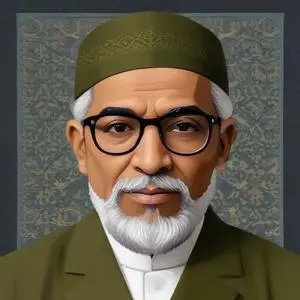
A renowned Islamic scholar and philosopher who interpreted Islamic thought in the context of modern philosophy, making Islamic philosophy more accessible to Western audiences.
Fazlur Rahman Malik, a renowned Islamic philosopher and modernist scholar, is widely recognized for his efforts to revive independent reasoning (ijtihad) and educational reform in Islam. Through his works, he aimed to bridge the gap between traditional Islamic knowledge and modern thought, earning him both accolades and criticism from the Muslim community.
Born on September 21, 1919, in the Hazara District of the North West Frontier Province (now Khyber Pakhtunkhwa, Pakistan), Fazlur Rahman Malik was exposed to Islamic scholarship from a young age. His father, Maulana Shihab al-Din, a well-known scholar, taught him the traditional Islamic sciences, and he memorized the entire Quran by the age of ten.
Fazlur Rahman Malik pursued higher education at Punjab University, where he studied Arabic, and later at Oxford University, where he wrote a dissertation on Ibn Sina (Avicenna). His academic background and research expertise laid the foundation for his future contributions to Islamic philosophy.
Fazlur Rahman Malik's academic career spanned across various institutions, including Durham University, where he taught Persian, and later, the Central Institute of Islamic Research in Pakistan, which he headed from 1963. During his tenure, he published several influential works, including "Islamic Methodology in History" and "Islam and Modernity: Transformation of an Intellectual Tradition."
His writings focused on the need for Islamic reform, emphasizing the importance of ijtihad and contextualizing Islamic principles in the modern world. While his ideas resonated with liberal reformers, they were met with criticism from conservative scholars, who deemed them too liberal and Western-influenced.
Fazlur Rahman Malik's liberal approach to Islam led to protests from over a thousand clerics, faqihs, muftis, and teachers in Pakistan, resulting in his exile to the United States in 1968. Despite the backlash, his works continued to inspire a new generation of Islamic scholars and reformers.
In the United States, he taught at the University of California, Los Angeles, and the University of Chicago, where he continued to promote his vision for Islamic reform and modernization.
Fazlur Rahman Malik's philosophy centered around the need for Muslims to engage with their faith in a more rational and contextual manner. He believed that Islam was not incompatible with modernity and that Muslims could benefit from embracing both traditional knowledge and modern thought.
He advocated for the revival of ijtihad, encouraging Muslims to think critically and independently, rather than relying solely on traditional interpretations. This approach, he believed, would enable Muslims to adapt to changing times while remaining faithful to their core beliefs.
Fazlur Rahman Malik's contributions to Islamic philosophy and reform have had a lasting impact on modern Islamic thought. His emphasis on ijtihad and contextualization has inspired a new generation of scholars and reformers, who continue to engage with Islamic principles in a more nuanced and dynamic way.
Through his life's work, Fazlur Rahman Malik demonstrated the importance of critically engaging with Islamic knowledge and promoting educational reform. His legacy serves as a testament to the power of intellectual curiosity and the need for continuous growth and development in the pursuit of knowledge.
Fazlur Rahman Malik's quotes and sayings continue to inspireMuslim scholars and thinkers, encouraging them to approach their faith with a critical and open-minded perspective.
Fazlur Rahman Malik's ideas have influenced modern Islamic thought, paving the way for a more nuanced and contextual understanding of Islamic principles. His emphasis on ijtihad and educational reform has contributed to a more dynamic and adaptive approach to Islam, allowing Muslims to engage with their faith in a more meaningful way.
His legacy extends beyond the realm of Islamic scholarship, inspiring a more inclusive and progressive approach to religious dialogue and interfaith understanding.
Born in 1877
A Pakistani philosopher, poet, and politician who played a key role in the creation of Pakistan and is revered for his philosophical and literary works that explored Islamic identity and nationalism.
94 Years Old
A renowned Islamic scholar and philosopher who interpreted Islamic teachings in a modern context, known for his progressive and reformist ideas.
73 Years Old
A legendary cricketer who led Pakistan to World Cup victory in 1992, and later became the country's Prime Minister, known for his charismatic leadership and anti-corruption stance.
82 Years Old
The Pakistani general and politician who seized power in a military coup and ruled Pakistan from 1999 to 2008, known for his controversial presidency and attempted assassination. He played a key role in Pakistan's politics and foreign policy during a tumultuous period.
98 Years Old
A charismatic leader who served as Pakistan's president and prime minister, known for his socialist and nationalist policies, and his role in developing Pakistan's nuclear program.
72 Years Old
The first female Prime Minister of a Muslim-majority country, known for her efforts to democratize Pakistan and promote women's rights. She was a symbol of hope for a more liberal and tolerant Pakistan.
Born in 1924
A Pakistani general and politician who ruled Pakistan from 1978 to 1988, implementing Islamic law and playing a key role in the Soviet-Afghan War. He's known for his authoritarian regime and controversial legacy.
