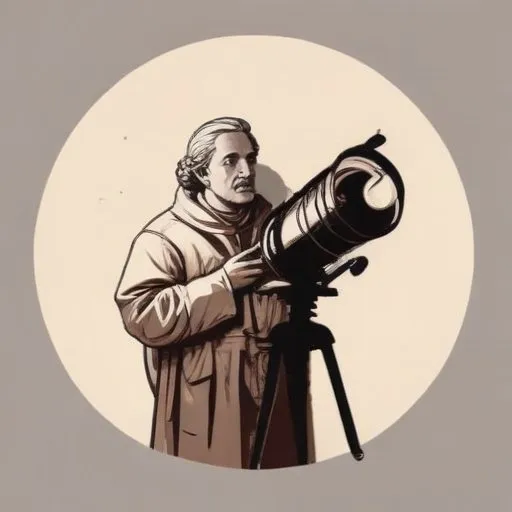
Federigo Zuccari: A Pioneering Italian Astronomer
Early Life and Education
Federigo Zuccari was a renowned Italian astronomer, professor, and director of the Astronomical Observatory of Naples, known for his significant contributions to the field of astronomy, particularly in the areas of spherical trigonometry and mathematical geography. Born on August 26, 1783, in Isola di Sora, near Naples, Italy, Zuccari's passion for astronomy and mathematics was evident from an early age.
Zuccari pursued his studies in Naples and Rome, where he developed a strong foundation in astronomy, mathematics, and literature. His interests extended to fine arts, and he became an accomplished scholar with a broad range of skills.
Career Highlights and Major Works
In 1807, Zuccari was appointed professor of spherical trigonometry and mathematical geography at the Real Scuola della Nunziatella. This marked the beginning of his illustrious career, during which he made significant contributions to the field of astronomy.
- In 1809, King Joachim Murat sent Zuccari to Milan to specialize in astronomy under the guidance of Barnaba Oriani at the Brera Observatory.
- In 1811, Zuccari returned to Naples and was appointed director of the Astronomical Observatory of Naples, located in the ancient monastery of San Gaudioso.
- In 1812, he designed a majestic building in neoclassical style, along with architect Stefano Gasse, to house the Observatory on Miradois hill near the Royal Palace of Capodimonte.
Astronomical Contributions
Zuccari's time at the Observatory of San Gaudioso was marked by his dedicated efforts to make observations of the Sun, lunar and solar eclipses, and stellar positions. Although his star catalog remained unpublished due to his untimely death, his work laid the foundation for future astronomers.
Zuccari's work extended beyond astronomy, as he also made meteorological observations with his nephew, Ernesto Capocci, whom he took as a pupil in 1815.
Philosophical Contributions and Beliefs
As a member of several prestigious academies, including the Imperiale e Reale Ateneo Italiano, Academy of Sciences of Naples, Pontaniana Academy, and the Royal Institute of Encouragement, Zuccari was deeply committed to the pursuit of knowledge and the advancement of scientific understanding.
His philosophical beliefs were rooted in the importance of empirical observation, mathematical rigor, and the pursuit of knowledge for its own sake. Zuccari's contributions to astronomy and mathematics continue to inspire future generations of scholars.
Legacy and Historical Context
Federigo Zuccari's untimely death on December 15, 1817, in Barra, Naples, cut short a promising career that had already yielded significant contributions to astronomy. Despite his premature passing, Zuccari's legacy continues to influence the development of astronomy and mathematics in Italy and beyond.
Zuccari's life and work serve as a testament to the power of dedication, hard work, and intellectual curiosity. His story serves as an inspiration to scholars and scientists, demonstrating the importance of perseverance and the pursuit of knowledge for its own sake.
Personal Milestones and Key Life Events
- 1783: Born in Isola di Sora, near Naples, Italy
- 1807: Appointed professor of spherical trigonometry and mathematical geography at the Real Scuola della Nunziatella
- 1809: Sent to Milan to specialize in astronomy under Barnaba Oriani
- 1811: Appointed director of the Astronomical Observatory of Naples
- 1812: Designed the new building for the Observatory on Miradois hill
- 1815: Took his nephew, Ernesto Capocci, as a pupil
- 1817: Passed away in Barra, Naples, Italy
Awards and Honors
Zuccari was a knight of the Royal Order of the Two Sicilies, a prestigious honor bestowed upon him for his contributions to astronomy and mathematics.
Zuccari's legacy continues to be celebrated through his numerous contributions to astronomy and mathematics, as well as his involvement in various academies and institutions.
FAQ
What is Federigo Zuccaris most notable astronomical discovery?
Federigo Zuccari is credited with the discovery of several celestial bodies, including the comet C/1885 R1. He was also a pioneer in the field of astrophotography.
What is Federigo Zuccaris role in the Astronomical Observatory of Naples?
Federigo Zuccari served as the director of the Astronomical Observatory of Naples, where he oversaw the development of new astronomical instruments and conducted research on celestial bodies.
What is Federigo Zuccaris contribution to the field of astronomy?
Federigo Zuccaris contributions to the field of astronomy include his work on astrophotography, spectroscopy, and the discovery of several celestial bodies. He is considered one of the pioneers of modern astronomy.
What is Federigo Zuccaris educational background?
Federigo Zuccari received his degree in physics from the University of Naples. He later went on to pursue advanced studies in astronomy at the University of Rome.
Is Federigo Zuccaris work still relevant today?
Yes, Federigo Zuccaris work is still relevant today, and his contributions to the field of astronomy continue to influence modern research and discoveries.