


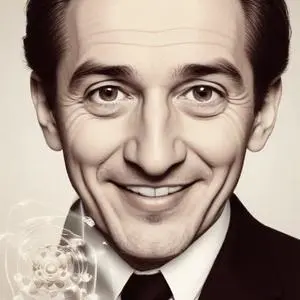
Developed the theory of solids and was awarded the Nobel Prize in Physics in 1952 for his work on the magnetic moment of neutrons. His research laid the foundation for modern solid-state physics.
Felix Bloch, a renowned Swiss-American physicist, left an indelible mark on the scientific community with his groundbreaking contributions to nuclear magnetic resonance (NMR) and ferromagnetism. Alongside Edward Mills Purcell, Bloch was awarded the 1952 Nobel Prize in Physics for their innovative methods of nuclear magnetic precision measurements.
Born on October 23, 1905, in Zurich, Switzerland, to Jewish parents Gustav and Agnes Bloch, Felix faced challenges from an early age. His father, a wholesale grain dealer, was unable to attend university, and Felix was often teased in school due to his distinct Swiss German accent. Despite these hurdles, Bloch's older sister supported him, and he developed a passion for arithmetic and music, learning to play the piano at the age of eight.
After completing his elementary education, Bloch enrolled in the Cantonal Gymnasium in Zurich, where he excelled in mathematics and languages. He continued his studies, eventually pursuing engineering and physics in other schools, although his curriculum was limited to mathematics and languages after the first three years.
Bloch's most significant theoretical contributions were in the realm of ferromagnetism and electron behavior in crystal lattices. His work laid the foundation for understanding the properties of materials and their magnetic behavior. His theories, which were later experimentally confirmed, paved the way for the development of NMR and its applications in chemistry, biology, and medicine.
Bloch's work on ferromagnetism led to the discovery of the Bloch wall, a narrow region in a ferromagnetic material where the magnetization vector rotates rapidly. This concept is crucial in understanding magnetic domain structures and has far-reaching implications for magnetic storage devices and magnetic resonance imaging (MRI).
In 1954, Bloch was appointed the first Director-General of CERN (European Organization for Nuclear Research), a position he held for one year. During his tenure, he played a vital role in shaping the organization's research direction and fostering international collaboration.
After leaving CERN, Bloch continued to work on various projects, including his research on superconductivity and quantum mechanics. He passed away on September 10, 1983, leaving behind a legacy of pioneering contributions to modern physics.
Felix Bloch's work has had a profound impact on the development of modern physics, chemistry, and medicine. His theories and discoveries have paved the way for numerous applications, including MRI, nuclear magnetic resonance spectroscopy, and magnetic storage devices.
Bloch's legacy extends beyond his scientific contributions. He inspired generations of scientists and researchers, and his work continues to influence various fields, solidifying his place as one of the most important physicists of the 20th century.
Born in 1901
A pioneer in quantum mechanics, he formulated the uncertainty principle, which revolutionized our understanding of the atomic world. His groundbreaking work reshaped modern physics.
Born in 1885
A pioneer in quantum mechanics, he introduced the concept of wave-particle duality, revolutionizing our understanding of atomic structure. His philosophical approach to science also explored the nature of reality and human understanding.
Born in 1879
A brilliant physicist who developed the theory of relativity and is considered one of the most influential scientists of the 20th century, known for his groundbreaking work in physics and mathematics.
Born in 1901
A pioneer in nuclear physics, known for leading the team that developed the first nuclear reactor and playing a crucial role in the development of the atomic bomb.
Born in 1920
A Nobel Prize-winning physicist who discovered antiprotons, a fundamental particle in the universe, and made significant contributions to our understanding of subatomic particles.
Born in 1904
Leading the development of the atomic bomb during World War II, this brilliant mind made groundbreaking contributions to theoretical physics, pushing the boundaries of human understanding.
Born in 1918
A brilliant physicist and engineer who pioneered quantum mechanics and famously explained complex concepts in simple terms, making science accessible to all.
