


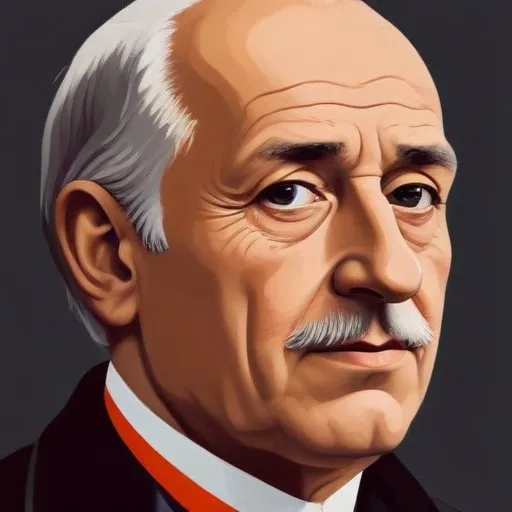
Developed groundbreaking theories in abstract algebra, particularly in group theory, and made significant contributions to number theory. His work laid the foundation for modern algebra and its applications.
Ferdinand Georg Frobenius was a renowned German mathematician, celebrated for his groundbreaking contributions to the theory of elliptic functions, differential equations, number theory, and group theory. His work laid the foundation for significant advancements in modern mathematics, earning him a prominent place in the annals of mathematical history.
Born on October 26, 1849, in Charlottenburg, a suburb of Berlin, Frobenius was the son of Christian Ferdinand Frobenius, a Protestant parson, and Christine Elizabeth Friedrich. He attended the Joachimsthal Gymnasium in 1860 and later pursued his university studies at the University of Göttingen in 1867. Frobenius then returned to Berlin, where he was deeply influenced by the lectures of Kronecker, Kummer, and Karl Weierstrass.
Frobenius received his doctorate with distinction in 1870 under the supervision of Weierstrass, with a thesis on the solution of differential equations. He went on to teach at secondary school level before being appointed as an extraordinary professor of mathematics at the University of Berlin in 1874. A year later, he moved to Zurich, where he became an ordinary professor at the Eidgenössische Polytechnikum, a position he held for 17 years.
Frobenius' most notable contributions include:
Frobenius' work has had a profound impact on modern mathematics and physics. The concept of Frobenius manifolds, introduced by him, plays a crucial role in differential geometry and has found applications in various fields, including string theory and M-theory.
His contributions have inspired generations of mathematicians, and his legacy continues to shape the development of mathematics and physics. Frobenius' work serves as a testament to the power of human ingenuity and the importance of fundamental research in advancing our understanding of the universe.
Frobenius married and raised a family in Zurich, where he spent 17 years of his academic career. He returned to Berlin in 1892, where he continued to work and make significant contributions to mathematics until his death on August 3, 1917.
Throughout his life, Frobenius was driven by a passion for mathematics and a desire to push the boundaries of human knowledge. His remarkable achievements serve as a reminder of the importance of dedication, perseverance, and intellectual curiosity.
Ferdinand Georg Frobenius' remarkable legacy continues to inspire mathematicians and scientists around the world. His work remains a testament to the power of human ingenuity and the importance of fundamental research in advancing our understanding of the universe.
Born in 1862
A renowned mathematician and academic who developed infinite-dimensional vector spaces and laid the foundation for quantum mechanics and relativity. He's also famous for his 23 unsolved math problems that shaped 20th-century mathematics.
Born in 1882
A pioneering mathematician and physicist who revolutionized abstract algebra and made groundbreaking contributions to modern physics, particularly in the development of Einstein's theory of general relativity.
Born in 1831
Developed a rigorous definition of real numbers and introduced the concept of Dedekind cuts, revolutionizing mathematics and laying the foundation for modern analysis. His work also explored the nature of infinity and the foundations of mathematics.
Born in 1823
A pioneer in number theory, this mathematician developed the concept of ideals and contributed significantly to the development of modern algebra. Their work laid the foundation for many mathematical advancements.
Born in 1854
A pioneer in mathematics and physics, he laid the foundations for modern chaos theory, topology, and relativity, making groundbreaking contributions to our understanding of space and time.
Born in 1849
A pioneer in geometry and group theory, known for developing the Erlangen program, which unified various geometries under a single framework. His work laid foundations for modern algebraic geometry and topology.
Born in 1777
A pioneer in mathematics and physics, he made major contributions to number theory, algebra, and electromagnetism, shaping our understanding of the natural world.
Born in 1826
A pioneering mathematician who developed the theory of higher dimensions and laid the foundations for modern physics, particularly in the understanding of space and time.
