


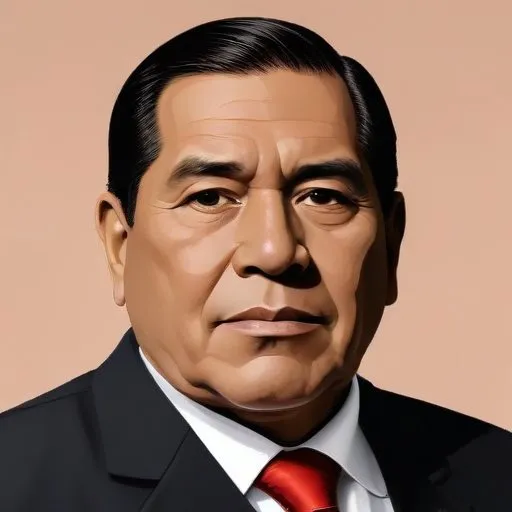
Peruvian architect and politician who served as President of Peru, implementing significant economic and social reforms, and promoting national identity through architecture.
Fernando Belaúnde Terry, a renowned Peruvian architect and politician, is best known for his transformative urban designs and his presidency of Peru from 1963 to 1968 and again from 1980 to 1985. His visionary approach to modernizing Peru's infrastructure, while preserving its cultural heritage, left an indelible mark on the country's development.
Born on October 7, 1912, in Lima, Peru, Belaúnde Terry came from a family of intellectuals and politicians. His father, Rafael Belaúnde Diez Canseco, was a prominent politician and diplomat. Belaúnde Terry pursued his passion for architecture at the National University of Engineering in Lima, graduating in 1935.
Belaúnde Terry's architectural career spanned over three decades, during which he designed numerous iconic buildings, including the National Stadium of Peru, the Faculty of Architecture at the National University of Engineering, and the Lima Civic Center. His modernist style, characterized by clean lines, simplicity, and functionality, revolutionized Peru's architectural landscape.
In 1956, Belaúnde Terry entered politics, founding the Popular Action (Acción Popular) party. He ran for president in 1956, 1962, and 1963, eventually winning the election in 1963. During his first term, he implemented extensive modernization projects, including the construction of highways, bridges, and public buildings.
Belaúnde Terry's presidential legacy is marked by his commitment to social and economic development, as well as his efforts to preserve Peru's cultural heritage. He established the National Institute of Culture and the Peruvian Institute of Sport, promoting the country's rich cultural diversity and athletic excellence.
During his second term, Belaúnde Terry faced significant economic challenges, including a severe crisis in 1983. However, he implemented innovative policies to address these issues, such as the creation of the National System of Support for Small and Medium-Sized Enterprises.
Belaúnde Terry received numerous awards and honors for his contributions to architecture, politics, and culture. He was awarded the Grand Cross of the Order of the Sun, Peru's highest honor, in 1964. He also received the Juan Pablo II Award from the Latin American Federation of Architects in 1984.
Belaúnde Terry was known for his strong sense of justice and his commitment to social equality. He believed in the importance of education and cultural development as the foundation of a prosperous society.
Belaúnde Terry's legacy extends beyond his architectural and political achievements. He inspired a generation of Peruvian architects, politicians, and public servants to prioritize the country's cultural heritage and modern development.
Today, his contributions continue to shape Peru's urban landscapes, cultural institutions, and political landscape. As a visionary leader and architect, Fernando Belaúnde Terry will be remembered as a champion of modernization, cultural preservation, and social progress.
88 Years Old
Peruvian engineer, academic, and politician who served as the 90th President of Peru, known for his authoritarian rule and controversial policies, including forced sterilizations and human rights abuses.
77 Years Old
The first democratically elected president of Peru to serve two non-consecutive terms, known for implementing neoliberal economic policies and facing corruption allegations.
88 Years Old
A Peruvian entrepreneur and politician who served as the 66th President of Peru, known for his economic reforms and efforts to combat corruption. He was also a World Bank economist and a Wall Street investment banker.
63 Years Old
The 67th President of Peru, an engineer-turned-politician, is known for his anti-corruption efforts and reforms, particularly in the judiciary and education systems. He's also recognized for his handling of the COVID-19 pandemic in Peru.
81 Years Old
Peruvian intelligence officer who led the National Intelligence Service and was a close advisor to President Alberto Fujimori, known for his corrupt and authoritarian practices. He was involved in numerous scandals, including bribery and human rights abuses.
90 Years Old
The first democratically elected president of Peru after a decade of authoritarian rule, known for stabilizing the country's economy and politics. He played a key role in Peru's transition to democracy.
80 Years Old
Peruvian economist and politician who served as President of Peru from 2001 to 2006, known for implementing economic reforms and promoting social programs. He's also recognized for his indigenous roots and advocacy for Andean communities.
