


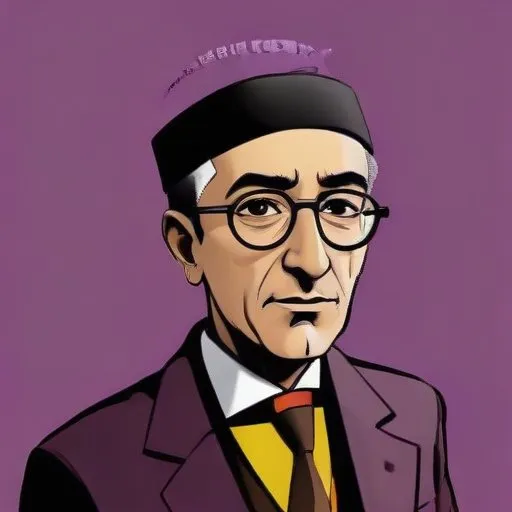
Developed innovative mathematical models to describe symmetries in physics, particularly in the areas of particle physics and relativity. Their work has had a significant impact on our understanding of the universe.
Feza Grsey, a Turkish mathematician and physicist, left an indelible mark on the world of theoretical physics with his groundbreaking contributions to the chiral model and SU6 symmetry of the quark model. His work in these areas has been instrumental in shaping our understanding of quantum field theory and its applications.
Born on April 7, 1921, in Istanbul, Turkey, Feza Grsey came from a family of intellectuals. His father, Reit Sreyya Grsey, was a military physician, and his mother, Remziye Hisar, was a pioneering Turkish chemist. This environment of intellectual curiosity and rigor laid the foundation for Grsey's future achievements. He completed his high school education at Galatasaray High School in 1940 and went on to receive his degree in Mathematics and Physics from Istanbul University in 1944.
Grsey's academic prowess earned him a scholarship from the Turkish Ministry of Education, which enabled him to pursue a doctorate degree at Imperial College London. He completed his work on the application of quaternions to quantum field theory in 1950. During his postdoctoral research at Cambridge University (1950-1951), he began to develop his theories on the chiral model and SU6 symmetry of the quark model.
Throughout the 1950s and 1960s, Grsey worked at various prestigious institutions, including Brookhaven National Laboratory, Institute for Advanced Study in Princeton, New Jersey, and Columbia University. His work during this period led to significant advances in our understanding of quantum chromodynamics. In 1961, he returned to Turkey and accepted the title of professor from Middle East Technical University (METU), where he played a crucial role in establishing the Department of Theoretical Physics.
Grsey's contributions to theoretical physics earned him numerous awards and honors. He was a fellow of the American Physical Society and a member of the Turkish Academy of Sciences. In recognition of his work, he received the Science Award of the Turkish Scientific and Technological Research Council in 1973.
Feza Grsey married Suha Pamir, a physics assistant, in 1952. The couple had two children together. Grsey's legacy extends beyond his scientific contributions. He was an inspiration to generations of Turkish scientists and mathematicians, and his work continues to influence researchers in the field of theoretical physics.
In conclusion, Feza Grsey's groundbreaking work in theoretical physics has left an indelible mark on our understanding of the universe. His contributions to the chiral model and SU6 symmetry of the quark model have inspired generations of scientists and continue to shape the course of research in the field.
Born in 1902
A Hungarian physicist and mathematician who made groundbreaking contributions to quantum mechanics and nuclear physics, and was awarded the Nobel Prize in Physics in 1963.
Born in 1903
Pioneering mathematician and physicist who developed the concept of the modern computer architecture and made significant contributions to quantum mechanics and game theory. His work laid the foundation for modern computing and artificial intelligence.
Born in 1902
A brilliant mind who formulated the Dirac equation, a fundamental concept in quantum mechanics, and predicted the existence of antimatter. His work revolutionized our understanding of the universe.
Born in 1908
A renowned physicist and academic who made groundbreaking contributions to our understanding of quantum mechanics, superfluidity, and particle physics, earning a Nobel Prize in Physics in 1962.
Born in 1904
A Ukrainian-American physicist and cosmologist who developed the Big Bang theory and wrote popular science books, making complex concepts accessible to a broad audience.
Born in 1910
A renowned scientist who pioneered our understanding of black holes and the behavior of stars, earning a Nobel Prize in Physics in 1983.
Born in 1923
A renowned physicist and mathematician who made groundbreaking contributions to quantum electrodynamics and futurism, proposing innovative ideas like the Dyson sphere.
97 Years Old
A pioneer in particle physics, discovering subatomic particles like quarks and gluons, and developing the theory of quantum chromodynamics.
