


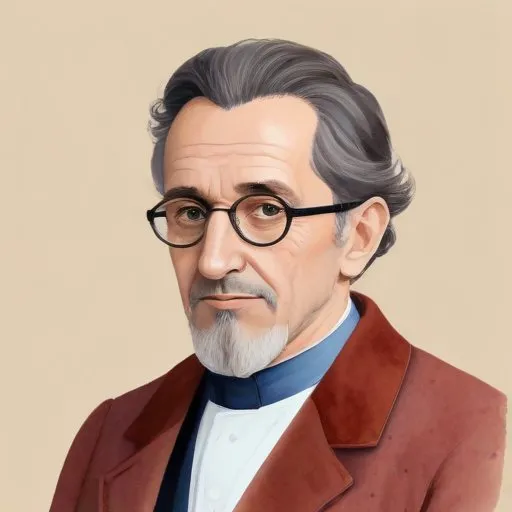
A 16th-century Renaissance humanist who developed a new philosophical system, combining Platonism and Hermeticism, and made significant contributions to the fields of astronomy, mathematics, and literature.
Francesco Patrizi, a 16th-century philosopher and theologian, is renowned for his groundbreaking work in the fields of metaphysics, epistemology, and the philosophy of science. He is particularly celebrated for his influential critique of Aristotle and his contributions to the development of modern scientific thought.
Born in 1529 in Cherso, Croatia, Patrizi was immersed in the world of philosophy and theology from a young age. He pursued his studies in Venice, Padua, and Bologna, eventually earning a degree in theology from the University of Ferrara.
Patrizi's magnum opus, Discussiones Peripateticae (1581), is a comprehensive critique of Aristotelian philosophy, which he deemed obsolete and inadequate for the emerging scientific discoveries of his time. Instead, he advocated for a more empirical and mathematical approach to understanding the natural world. His work had a profound impact on the development of modern science, influencing thinkers like Galileo Galilei and Francis Bacon.
Patrizi's philosophical ideas permeated various aspects of Renaissance thought, shaping the course of scientific inquiry, theology, and philosophy. His emphasis on empirical observation and mathematical reasoning laid the groundwork for the scientific revolution of the 17th century.
Patrizi's life and work were marked by a commitment to intellectual honesty and a desire to challenge established authority. His critiques of Aristotelian philosophy and his advocacy for a more modern scientific approach earned him both praise and criticism from his contemporaries. Despite facing opposition, Patrizi remained steadfast in his pursuit of knowledge, leaving behind a rich legacy that continues to influence philosophical and scientific discourse.
Patrizi's work shared affinities with other Renaissance thinkers, such as Copernicus and Telesio, who also sought to challenge Aristotelian dominance. His emphasis on empirical observation and mathematical reasoning mirrored the approaches of Galileo and Kepler, who would later build upon his ideas.
In 1592, Patrizi was appointed as the professor of philosophy at the University of Ferrara, a position he held until his death in 1597. During his tenure, he mentored and influenced a generation of young scholars, ensuring the perpetuation of his ideas.
"The truth of things is not to be sought in the books of the ancients, but in the very nature of things themselves." - Francesco Patrizi
Francesco Patrizi's trailblazing legacy continues to inspire and inform philosophical and scientific inquiry to this day. His courage to challenge established authority, his commitment to intellectual honesty, and his vision for a more modern scientific approach have left an indelible mark on the history of thought.
Born in 1463
Renaissance humanist and philosopher who wrote the famous "Oration on the Dignity of Man," a treatise that declared human beings' potential for greatness and their capacity for self-improvement. He's known for his emphasis on humanism and individualism.
Born in 1433
An Italian Renaissance philosopher who translated Plato's works into Latin, reviving classical Greek philosophy and influencing the development of Western esotericism. He's also known for his astrological writings and their impact on Renaissance thought.
Born in 1462
An Italian Renaissance philosopher who challenged the dominant Aristotelian views, arguing that the soul is mortal and that morality is based on human nature rather than divine law.
Born in 1550
A 17th-century philosopher and writer who challenged Aristotelian views and developed a rational approach to understanding the natural world, influencing the scientific revolution.
Born in 1533
A 16th-century philosopher and logician who developed a new approach to Aristotelian logic, influencing the development of modern scientific method. He's known for his work on the methodology of science and the role of experience in knowledge formation.
