


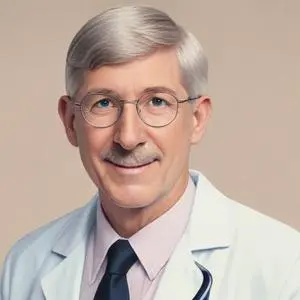
Led the Human Genome Project, decoding human DNA and paving the way for genetic medicine. Currently directs the National Institutes of Health, shaping biomedical research and policy.
Francis Collins is a renowned American physician-scientist who has made groundbreaking contributions to the field of genomics, leading to the discovery of genes associated with various diseases. He is perhaps best known for his leadership of the Human Genome Project, a monumental undertaking that has revolutionized our understanding of human biology and disease.
Collins was born on April 14, 1950, in Staunton, Virginia, to Fletcher and Margaret Collins. He grew up on a small farm in Virginia's Shenandoah Valley and was homeschooled by his parents. Collins' curiosity and passion for science led him to pursue higher education, earning his Bachelor's degree in chemistry from Virginia Tech in 1970. He then went on to earn his Ph.D. in physical chemistry from Yale University in 1974 and his M.D. from the University of North Carolina at Chapel Hill in 1977.
Collins' research career began at the University of Michigan, where he earned a reputation as a skilled "gene hunter." His work led to the discovery of several genes associated with diseases, including cystic fibrosis and Huntington's disease. In 1993, he was appointed as the director of the National Human Genome Research Institute (NHGRI), where he oversaw the Human Genome Project. Under his leadership, the project was completed in 2003, two years ahead of schedule and under budget.
In 2009, Collins was appointed as the director of the National Institutes of Health (NIH), a position he held until 2021. During his tenure, he was instrumental in launching several major research initiatives, including the Brain Research through Advancing Innovative Neurotechnologies (BRAIN) Initiative and the Precision Medicine Initiative. Collins has received numerous awards and honors for his contributions to science and medicine, including the Presidential Medal of Freedom, the National Medal of Science, and the Albert Lasker Award.
In addition to his scientific pursuits, Collins has also written extensively on the relationship between science and faith. His book, The Language of God: A Scientist Presents Evidence for Belief, explores the intersection of science and spirituality, arguing that belief in Christianity can be reconciled with acceptance of evolution and science. Collins has also founded the BioLogos Foundation, which promotes discourse on the relationship between science and religion.
Francis Collins' contributions to genomics, medicine, and science have had a profound impact on our understanding of human biology and disease. His leadership and vision have inspired a new generation of scientists and researchers, and his work continues to shape the course of medical research and discovery. As a remarkable individual who embodies the intersection of science, faith, and humanity, Collins' legacy will undoubtedly endure for generations to come.
79 Years Old
Pioneering geneticist who sequenced the human genome and created the first self-replicating synthetic cell, revolutionizing our understanding of life and its potential. 82
98 Years Old
Discovered the structure of DNA, revolutionizing our understanding of genetics and earning a Nobel Prize. Pioneering work in molecular biology has far-reaching implications for medicine and beyond.
69 Years Old
A renowned mathematician and geneticist who pioneered the Human Genome Project, leading to major breakthroughs in genetic research and personalized medicine.
85 Years Old
Leading the National Institute of Allergy and Infectious Diseases, this renowned expert has been at the forefront of combating infectious diseases, including HIV/AIDS and COVID-19, providing critical guidance to governments and the public.
86 Years Old
A Nobel Prize-winning biologist who made groundbreaking discoveries in cancer genetics, leading to a deeper understanding of the disease and its treatment. His work has saved countless lives and paved the way for future research.
