


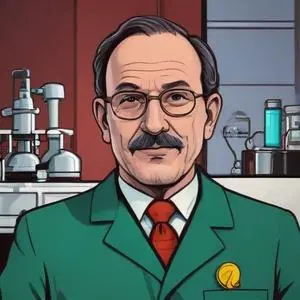
A Nobel Prize-winning biologist who made groundbreaking discoveries in cancer genetics, leading to a deeper understanding of the disease and its treatment. His work has saved countless lives and paved the way for future research.
Harold E. Varmus is a renowned American scientist and Nobel laureate, celebrated for his groundbreaking discovery of the cellular origin of retroviral oncogenes. Alongside J. Michael Bishop, Varmus was awarded the 1989 Nobel Prize in Physiology or Medicine for his pioneering work in the field of oncogenes, which has significantly advanced our understanding of cancer.
Varmus was born on December 18, 1939, to Beatrice, a social service worker, and Frank Varmus, a physician, in Oceanside, New York. He grew up in a family of Jewish immigrants from Eastern Europe. Varmus graduated from Freeport High School in 1957 and went on to study English literature at Amherst College, initially intending to follow in his father's footsteps as a medical doctor.
After graduating from Amherst, Varmus earned an M.A. in English at Harvard University in 1962. However, he soon changed his mind and applied to medical schools, only to be rejected twice from Harvard Medical School. Undeterred, he enrolled at Columbia University College of Physicians and Surgeons and later worked at a missionary hospital in Bareilly, India, and the Columbia Presbyterian Medical Center.
As an alternative to serving militarily in the Vietnam War, Varmus joined the Public Health Service at the National Institutes of Health in 1968. Working under Ira Pastan, he researched the regulation of bacterial gene expression by cyclic AMP. In 1970, he began postdoctoral research in Bishop's lab at the University of California, San Francisco, where he made the groundbreaking discovery of the cellular origin of retroviral oncogenes.
Varmus has been a vocal advocate for the importance of basic scientific research in advancing our understanding of human health and disease. He believes that investing in scientific research is crucial for driving innovation and improving human health.
Varmus's discovery of the cellular origin of retroviral oncogenes has had a profound impact on our understanding of cancer and has paved the way for the development of targeted therapies. His work has also inspired a new generation of scientists to pursue careers in cancer research.
Harold E. Varmus is a trailblazer in the field of cancer research, and his contributions have had a lasting impact on our understanding of the disease. As a scientist, leader, and advocate, Varmus continues to inspire and shape the scientific community, driving progress toward a future where cancer is better understood and more effectively treated.
98 Years Old
Discovered the structure of DNA, revolutionizing our understanding of genetics and earning a Nobel Prize. Pioneering work in molecular biology has far-reaching implications for medicine and beyond.
Born in 1916
Pioneering scientist who discovered the structure of DNA, revolutionizing our understanding of genetics and life itself.
Born in 1920
A British scientist who contributed significantly to the discovery of the structure of DNA, providing high-quality X-ray crystallography images that helped James Watson and Francis Crick develop their famous model.
Born in 1916
A Nobel Prize-winning physicist and biologist who contributed significantly to the discovery of the structure of DNA, using X-ray crystallography to produce the first clear images of the molecule.
Born in 1901
Pioneering chemist and peace activist who won two unshared Nobel Prizes, one for chemistry and one for peace, for his groundbreaking work on the nature of the chemical bond and his tireless efforts to promote nuclear disarmament.
Born in 1905
A pioneer in DNA research, this biochemist discovered the base pairing rules of DNA, leading to a fundamental understanding of genetic code.
Born in 1850
A Nobel Prize-winning biologist who made groundbreaking discoveries in molecular biology, particularly in understanding the replication of viruses and DNA.
Born in 1914
A pioneering virologist who discovered that certain viruses can transform normal cells into cancer cells, leading to a deeper understanding of cancer development. His work has greatly advanced cancer research and treatment.
