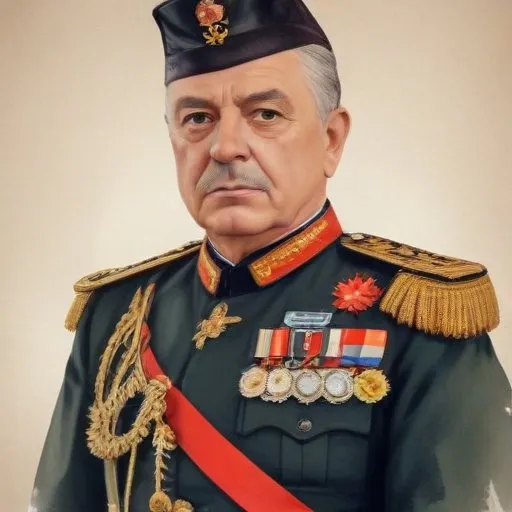
Francisco Craveiro Lopes: The Portuguese President Who Challenged the Status Quo
A Career Marked by Military Service and Political Ambition
Francisco Craveiro Lopes is best known for serving as the 12th President of Portugal from 1951 to 1958, a period marked by his tumultuous relationship with Prime Minister
António de Oliveira Salazar. Born on April 12, 1894, in Lisbon, Portugal, Craveiro Lopes was a son of João Carlos Craveiro Lopes, a Portuguese army general and Governor-General of Portuguese India.
Military Background and Early Career
Craveiro Lopes' military background played a significant role in shaping his future in politics. He concluded his studies at the Colégio Militar in 1911 and later joined the Escola Politénica de Lisboa. In 1911, he also joined a cavalry regiment, marking the beginning of his military career. His military service took him to Portuguese India, where he succeeded his father as the 123rd General Governor from 1936 to 1938. During the Spanish Civil War, Craveiro Lopes served as the commander of the Portuguese volunteer forces.
Rise to the Presidency
In 1951, Craveiro Lopes was chosen by Prime Minister Salazar as the regime's presidential candidate, succeeding the late Óscar Carmona. Initially, he was to run in a contested election against naval officer Manuel Quinto Meireles, but Meireles eventually withdrew, and Craveiro Lopes was elected unopposed.
A Presidential Term Marked by Tension with Salazar
As President, Craveiro Lopes was vested with near-dictatorial powers, but in practice, Salazar wielded significant control over the government. Craveiro Lopes, however, was not willing to give Salazar the same level of autonomy enjoyed by his predecessor, Carmona. This led to a tense relationship between the two, with Craveiro Lopes occasionally challenging Salazar's authority.
Downfall and Legacy
In 1958, Salazar picked
Américo Tomás, a naval minister, as the regime's candidate, effectively ending Craveiro Lopes' term as President. Craveiro Lopes was approached by the Democratic Opposition to be their candidate, but he declined, aware that he stood little chance of winning. As a compromise, the regime promoted him to Marshal, a high military honor.
Personal Milestones and Key Life Events
- Born on April 12, 1894, in Lisbon, Portugal
- Succeeded his father as the 123rd General Governor of Portuguese India from 1936 to 1938
- Served as commander of the Portuguese volunteer forces during the Spanish Civil War
- Became the 12th President of Portugal in 1951
- Lost power struggle with Salazar in 1958
- Died on September 2, 1964
Impact on Modern Society
Craveiro Lopes' presidency marked a significant turning point in Portuguese politics, as it highlighted the fragility of the authoritarian regime and the limits of presidential power. His challenges to Salazar's authority paved the way for future generations of politicians to push for democratic reforms.
Philosophical Contributions and Beliefs
While Craveiro Lopes' presidency was marked by his power struggle with Salazar, his beliefs and philosophical contributions remain relatively unknown. It is clear, however, that he was committed to the ideals of the Estado Novo, even if he disagreed with its authoritarian implementation.
Influence on Portuguese Politics
Francisco Craveiro Lopes' legacy continues to influence Portuguese politics, serving as a reminder of the importance of democratic institutions and the need for checks and balances on executive power. His presidency marked a crucial moment in Portugal's transition towards democracy, paving the way for future generations of politicians to build a more just and equitable society.
FAQ
What was Francisco Craveiro Lopes role in Portuguese politics?
Francisco Craveiro Lopes was a Portuguese field marshal and politician who served as the 13th President of Portugal from 1951 to 1958. He played a significant role in maintaining stability and continuity during a period of political change in Portugal.
What were Francisco Craveiro Lopes major achievements as President of Portugal?
Francisco Craveiro Lopes presidency was marked by significant economic growth, modernization, and investment in infrastructure. He also played a key role in maintaining Portugals relationships with other European countries and the United States.
How did Francisco Craveiro Lopes influence Portuguese foreign policy?
Francisco Craveiro Lopes presidency had a significant impact on Portuguese foreign policy, particularly in relation to the countrys colonies and its relationships with other European nations. He worked to strengthen Portugals position within the international community and promote economic cooperation.
What is Francisco Craveiro Lopes legacy in Portuguese history?
Francisco Craveiro Lopes is remembered as a respected and influential figure in Portuguese history, celebrated for his role in maintaining stability and promoting economic growth during a period of change and uncertainty.
How did Francisco Craveiro Lopes balance his military and political careers?
Francisco Craveiro Lopes successfully balanced his military and political careers, leveraging his experience as a field marshal to inform his political decisions and provide strong leadership during a period of transition in Portugal.